
Today’s Post by Joe Farace
Though we travel the world over to find the beautiful, we must carry it with us or we find it not. — Ralph Waldo Emerson
When it comes to caring for photo equipment, there seems to be, at least, three kinds of photographers: The first group includes an old friend of mine whose idea of cleaning a lens is to lick its front element and wipe it off with a pulled-out shirttail. This is the same guy, who drove nails with a Nikon 200mm lens. Maybe he’s trying to give his equipment that patina of wear often seen on equipment sported by globe-hopping photojournalists. I consider this first group of people to be the Oscar Madisons of photography.
At the opposite extreme is (obviously) Felix Unger. Their equipment looks as if they never use it. There’s no brassing on their black camera bodies, no dust would dare land on their lenses and they never leave the house without a full supply of camera and lens cleaning products. In between these two extreme is a third group that includes most of us but I will confess to having more than a few Unger-like impulses about caring for my photo equipment.

How I made this shot: Tulum is the site of a pre-Columbian Mayan walled city that served as a major port in the Mexican state of Quintana Roo. The ruins are situated on 39 foot (12-meter) tall cliffs along the east coast of the Yucatán Peninsula on the Caribbean Sea. Tulum was one of the last cities built by the Maya and achieved its greatest prominence between the 13th and 15th centuries. This image of some of the ruins was made using a Contax G1 with 45mm f/2 Planar T* Carl Zeiss lens on Kodak color negative film, exposure unrecorded.
Using a LensPen
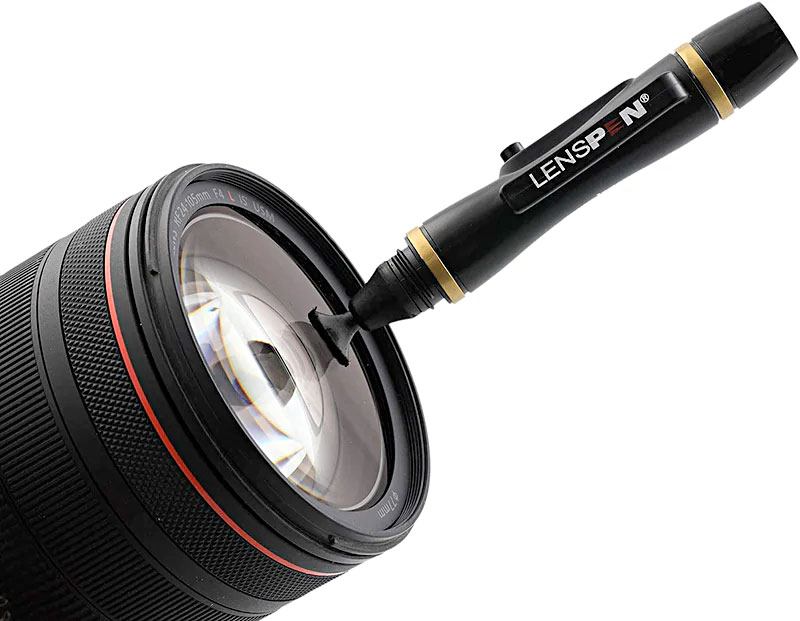 To clean my lenses or camera filters, I like to use a LensPen Black Series and keep one in each of my camera bags. It’s understated design makes it inconspicuous so I can stick it in a shirt pocket when traveling light. A LensPen has a retractable natural hair brush you can use to knock off chunks of dust from your photo gear and a soft chamois-like tip on the other end to remove lens smudges. The carbon based cleaning compound the tip uses reduces electrostatic charges that can attract dust to a lens surface and it replenishes itself after each use. Since a LensPen doesn’t require cleaning fluid or lens tissue, it creates no trash, so its ecologically friendly. You should be wary of imitations and many times fake LensPen products have nothing on the cleaning tip so they can damage the lens surfaces they’re meant to clean.
You can use a LensPen on all optical lenses, LCD and glass surfaces. It’s perfect for cleaning camera lenses, binocular lenses and telescope eyepieces. A LensPen Black Series measures 4.33-inches (11cm) long and has a round cleaning tip that measures slightly less than on-half-inch (12mm) in diameter and has a non-liquid cleaning element designed never to dry out. A LensPen slips into a pocket and is easy to use. Here’s how:
- Start by using the retractable brush to lightly remove any dust from your lens.
- Twist off the cap and move the cleaning tip in circular motions on the lens to clean it. If any smudges remain, gently breath on the lens and repeat.
- LensPens are designed to be used with dry, optical glass surfaces; Do not use on wet or plastic lenses. I know they’re out there.
Best of all a LensPen Black Series only costs $12.95, so you can afford to put one in each of your camera bags. With vacation time coming up. a brand-new LensPen makes a perfect travel companion for yourself or your favorite photographer!
LensPen is a long-time sponsor of my sites and blogs but I was using their products long before I even had a blog. My wife bought me my first LensPen in 1994 just after I acquired a brand-new Nikon N90s film-based SLR! I would like to thank LensPen for their continued support.