
Today’s Post by Joe Farace
I love driving cool cars, but there is nothing like driving a pickup truck. ― Dwayne Johnson
The ISO (International Standards Organization) standard is a way to quantify a film’s sensitivity to light—digital is coming in the next paragraph. Lower numbers, such as 50 or 100, represent less sensitivity; while higher numbers, such as 800 or 1600, show a film that’s more sensitive to light. Conveniently, ISO numbers are proportional to their sensitivity to light. As you double or halve an ISO number, you double or halve the film’s sensitivity to light. Film with an 800 ISO is twice as sensitive to light as 400, and 800 film is half as sensitive to light as 1600.
 You may be surprised to learn that despite what it says on your DSLR or mirrorless camera’s dial, button or LCD screen, digital cameras don’t have true ISO settings, which is why you’ll sometimes see the term “ISO Equivalent,” tossed around in camera specifications. Over time manufacturers have developed technologies to let their imaging sensors respond similarly to the way that film responds to light. DSLRs and mirrorless cameras offer a range of ISO speeds but all you really need to know that when you set a digital camera to ISO 400, you can expect a similar response to light than ISO 400 film would produce.
These days camera manufacturers are offering higher and higher ISO settings with their latest cameras. The full-frame Pentax K-1 Mark II, for example, has a maximum ISO setting of 819,200.
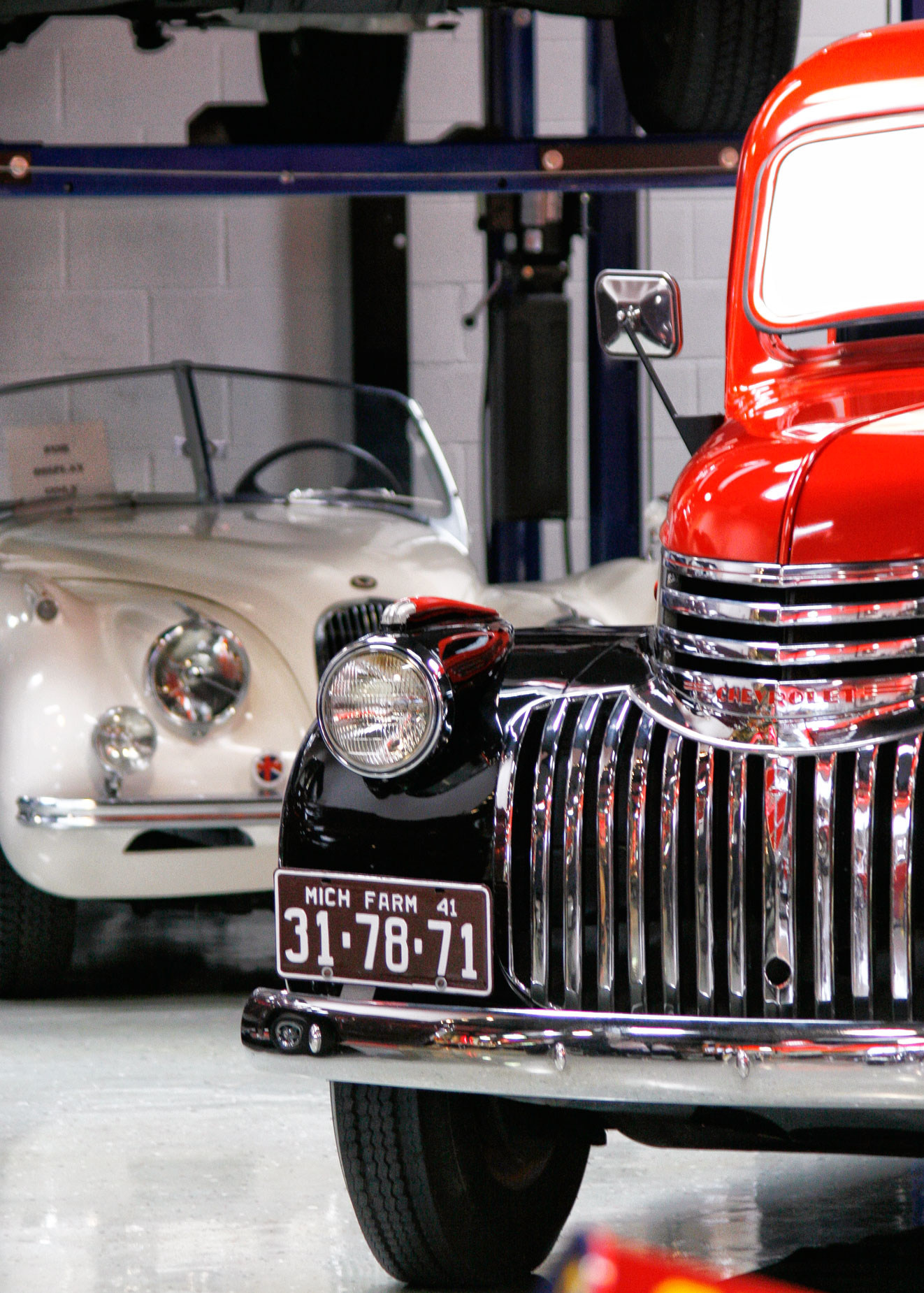
How I made this shot: This image showing two classics was made at the San Diego Collection using a Canon EOS 30D with EF75-300mm f/4-5.6 IS USM lens at 155mm. The image was made with an exposure of 1/40 sec at f/5 and ISO 640 with a plus one-thirds stop exposure compensation.
Back to Film
For a final comparison: When film is exposed at slow shutter speeds, it becomes less sensitive to light and, in turn, shifts color balance an condition that’s caused by reciprocity failure. For film, reciprocity is accurate over a specific range of values of exposure duration but only becomes inaccurate when departing from this range. Fortunately, digital cameras are not afflicted by this problem. That’s the good news, the bad news is that during long exposures and high ISO settings there is a corresponding increase in digital noise. You can read more about noise here.
 PS: Just a reminder: The Pixels Grain & Cookies Podcast #5 is live now on my YouTube channel, Joe Farace’s Videos, where the boys take a brief look at CCD vs. CMOS sensors before doing a deep dive into a question many people have—How Many Megapixels is Enough.
Along with photographer Barry Staver, Joe is co-author of Better Available Light Digital Photography that’s available for new for $21.50 with used copies for giveaway prices—aeound twelve bucks—from Amazon, as I write this.