
Today’s Post by Joe Farace
“Some older people want their final days to kick back and relax, and God bless them. Me? I will die at the drag strip. I know it’s already in the books, and as far as I’m concerned it’s a good way to end my movie.” – John Force (1949- ),16-time NHRA champion driver
Drag racing, as a sport, originated in the 1940s fueled by World War II veterans interested in creating unique hot rods that were designed for one purpose—to go fast! It’s a form of motor racing where two cars line up, head to head to compete to see who’s the first to cross the finish line. Originally is happened on the street but in 1951, Wally Parks formed the National Hot Rod Association (NHRA) and moved the racing to tracks that were often landing strips in decommissioned aircraft bases making them an ideal place for the sport before creating dedicated race facilities. It is a uniquely American form of racing with all the pageantry and noise any car enthusiast could want. I love it.
Photographing Race Cars a Quarter Mile at a Time
There’s an old racer’s expression that says, “there’s no substitute for cubic inches.” Translating that into my advice for photographing drag racing action into one of Farace’s Rules it becomes: There’s no substitute for millimeters of focal length. My guess is that some of your best drag racing images will be captured with zoom lenses that have a 200-300mm (or more) focal length and maybe sticking a 1.4 extender in your pocket isn’t a bad idea either.
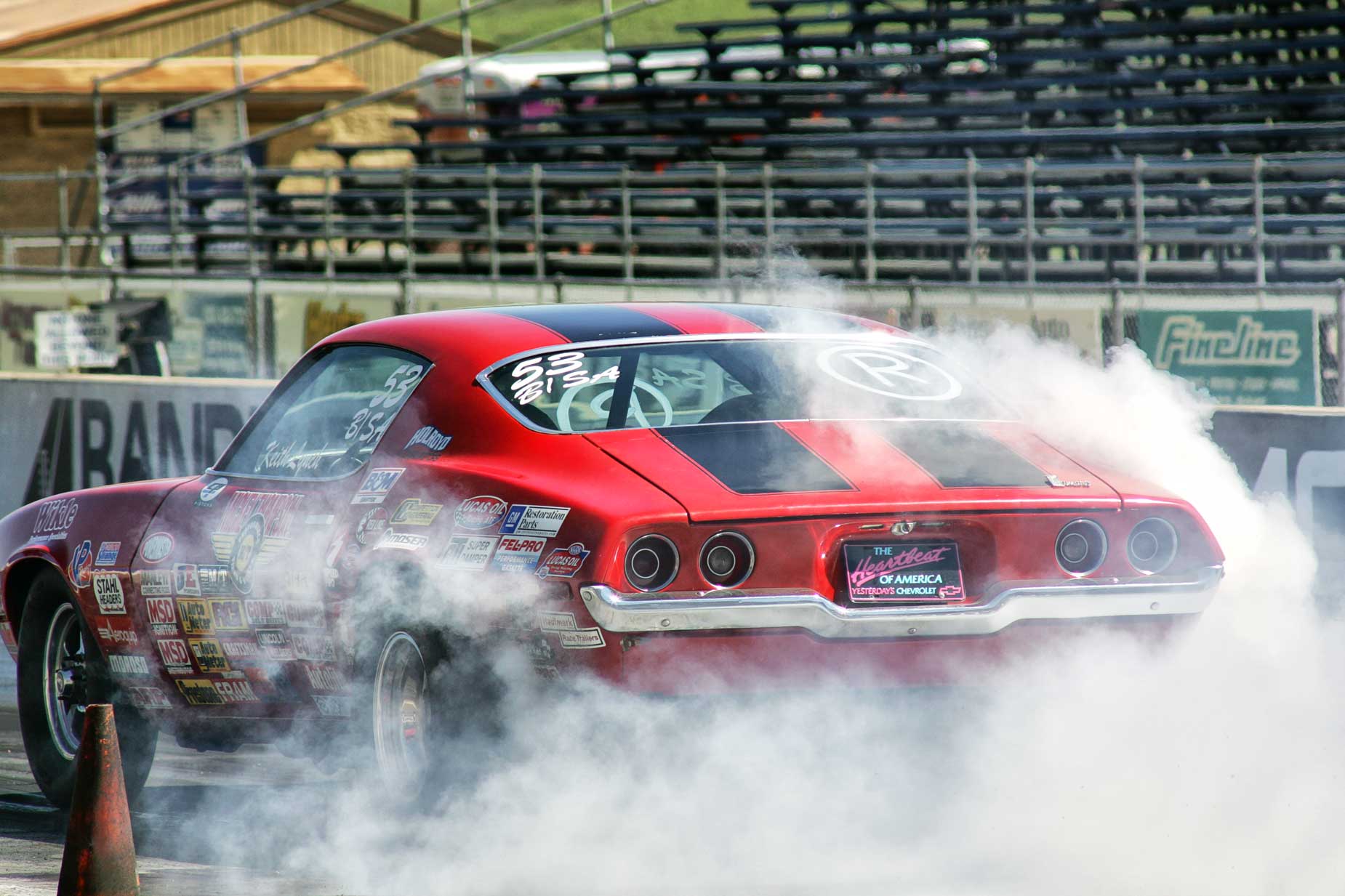
How I Made this Photograph: The above (uncropped) image was photographed at Denver’s (former, see below) Bandimere Speedway. The camera used was my old workhorse Canon EOS 1D Mark II N with an EF 70-300mm f/4-5.6 IS USM lens (at 200mm) with an exposure of 1/800 sec at f/8 and ISO 200 and a minus one-third stop exposure compensation. Unlike other forms of motorsports, you can sometimes get close enough to the action to photograph it using a wide-angle lens. For images made in the pits I’ll usually bring a wide-angle zoom; I like the EF16-35mm f/2.8 L II USM.
The essence of drag racing is head to head competition between two cars going full tilt down a straight smooth track.
For action shots at the Christmas tree, like the above image, I usually shoot a short burst of images using the camera’s continuous mode. Exposure is critical for these kinds of shots because there is no time for bracketing, so right before a race I’ll shoot several test shots and then make exposure adjustments via the exposure compensation feature all day long by looking at captured image’s histogram. OK, let’s call it what it really is—chimping.
You can photograph drag racing without knowing the difference between a “Christmas tree” and a Hanukkah bush but you’ll get better pictures if you do just a little research about the sport before trying to make any images. Visit the National Hot Rod Association’s website for information about the sport and read a copy of their publication National Dragster. The website has a link to locations where you can buy a copy. Or ask a knowledgeable friend. Or just do some research on-line. Like any photographic venture that’s new to you, be prepared before packing up you camera bag and heading to the track.
Just a reminder: Barry Staver’s and Joe’s Podcast #3 is live now on my YouTube channel, Joe Farace’s Videos, featuring a look at old film cameras, and new digital cameras with the podcast wrapping up with the guys answering questions about who their photographic influences were and are.