
Today’s Post by Joe Farace
The cars we drive say a lot about us.—Alexandra Paul
First a little bit of history: Saab Automobile AB was founded in Sweden in 1945 when its parent company, who built airplanes, began a project to design a small automobile. The first production model, the Saab 92, was launched in 1949. In 1968 the parent company merged with Scania-Vabis and ten years later the Saab 900 was launched, becoming Saab’s best-selling model. In the mid-1980s the Saab 9000 model appeared.
General Motors took 50 percent ownership of the company and two models that come out of this period were the Saab 9-3 and the Saab 9-5. Then in 2000, GM exercised its option to acquire the remaining 50 percent. In 2010 GM sold Saab Automobile AB to the Dutch automobile manufacturer Spyker Cars. After struggling to avoid insolvency throughout 2011, SAAB petitioned for bankruptcy following the failure of a Chinese consortium to buy the company; the purchase being blocked by General Motors, who stated they “opposed the transfer of technology and production rights to a Chinese company.”
In June 2012, it was announced that National Electric Vehicle Sweden (NEVS) had bought Saab Automobile’s though its bankrupt estate. NEVS lost its license to manufacture automobiles under the Saab name (which the original aerospace company still owns) in the summer of 2014 and later produced electric cars based on the Saab 9-3 but under its own new car designation NEVS. While there’s more, there’s no happy ending for this storied marque. For a chronological and more detailed video update on “What really happened to SAAB” click that link.
How made this photograph:
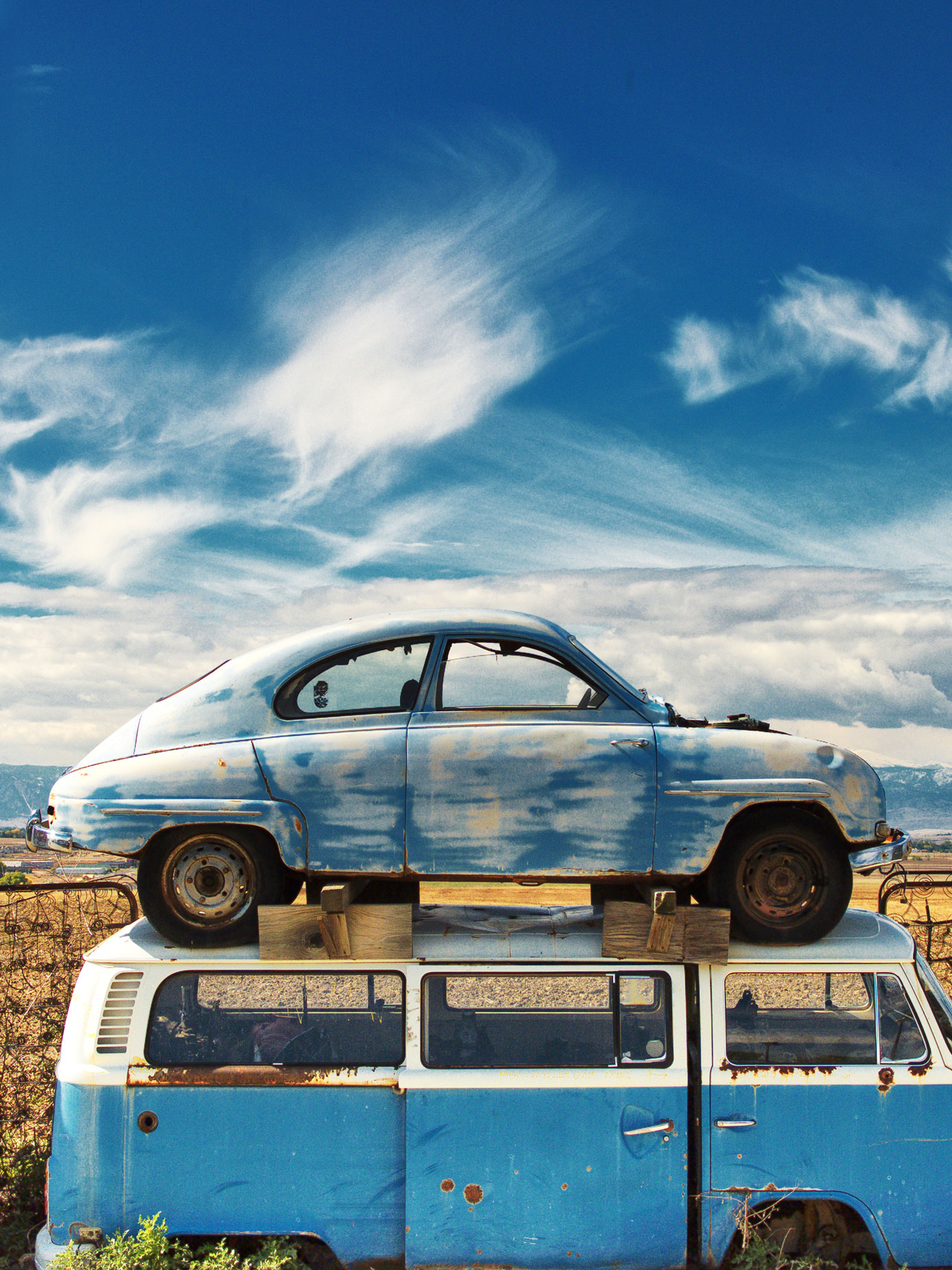 The image at right was made at a import car recycling center located near Erie, Colorado, which I believe (and hope) is still in business. The camera used was a Leica R9 film-based SLR with Leica’s Digital-Modul-R back. (More about that below.) The lens was a 100mm f/2.8 APO Elmarit R Macro with an exposure of 1/750 sec at f/9.5 and ISO 200. Even today, the original JPEG file looks impressive at just 10-megapixels.
Some Background: In 2003 Leica announced the Digital-Modul-R that was designed for its R8 and R9 film SLRs. The 10-megapixel Digital-Modul-R was a stop gap solution and a clever one at that, that converted Leica’s chunky R8 and R9 35mm film cameras into DSLRs. It cost $5950 in 2006 dollars or about $9,125 today. Finding one today seems to be a challenge.
The module consisted of two parts, a digital back that clipped onto the rear of the camera and a power unit that fit the base. The digital back used a ten-megapixel (26.4 x 17.6mm) APS-H Kodak sensor so beloved by contemporary shooters because of it’s ability to produce film-like results. This sensor that had a 1.37x multiplication ratio and a sensitivity range of ISO 100 to 800. When Shutterbug was still a print magazine, I got to review a Digital-Modul-R and shoot it with a Leica R9 body. I loved using it so much, that I bought an R8 body just so I could add a Digital-Modul-R to it but was, alas never able to afford the digital back.
Postscript: Although I’ve owned a number of different cars over the years, I have never owned a SAAB automobile. Mary came close to purchasing a 9-3 back when they were still available but found the seats to be uncomfortable (it’s one of her hot buttons) and I came close to buying an red Saab Aero wagon a few years ago but we were too late getting to the dealer and someone else beat us to it. Instead I ended up with a red 2014 Mercedes-Benz CLA 250, and you all know how that all tuned out.
If you enjoyed today’s blog post and would like to treat Joe to a cup of Earl Grey tea ($2.50), click here. And if you do, thank you.