
It’s #wheelswednesday and it’s also It’s National Root Beer Float Day and wish I had one of those delicious ice cream drinks in my poor beat up hands right now. Instead we’ll take a look at one of my favorite automobile marques—Buick, in infrared
Today’s Post by Joe Farace
“Every object in the Universe with a temperature above absolute zero radiates in the infrared, so this part of the spectrum contains a great deal of information.”—Frank J. Low
Why do I like Infrared Photography? It’s because….digital infrared photography has the power to transform the most mundane visual experiences into something that’s unforgettable. One of my favorite stories was from a reader whose photography time was limited to his lunch hour. That was the worst time for traditional photography but is the “golden hour” for infrared and he was able to create interesting and somewhat magical images during that time. If you’re interested in giving infrared photography a try….
…Here’s One Way to Do It
One way to do it is by purchasing a used digital DSLR or mirrorless camera and converting it to infrared capture. Another, even simpler method is purchasing an already IR-converted camera, Either option is a good way to get started in infrared photography because used camera bodies typically sell for a lower price (than new.) When starting with a used, unconverted camera, the cost of conversion when added to the purchase price shouldn’t break your piggy bank, especially if you’re serious about infrared capture. Or you could convert one of your older cameras that you’re not using since you’ve updated to a newer model and the older one is just sitting around collecting dust. Tip: Just remember that after any camera has been converted for IR, you can only shoot infrared images with it.
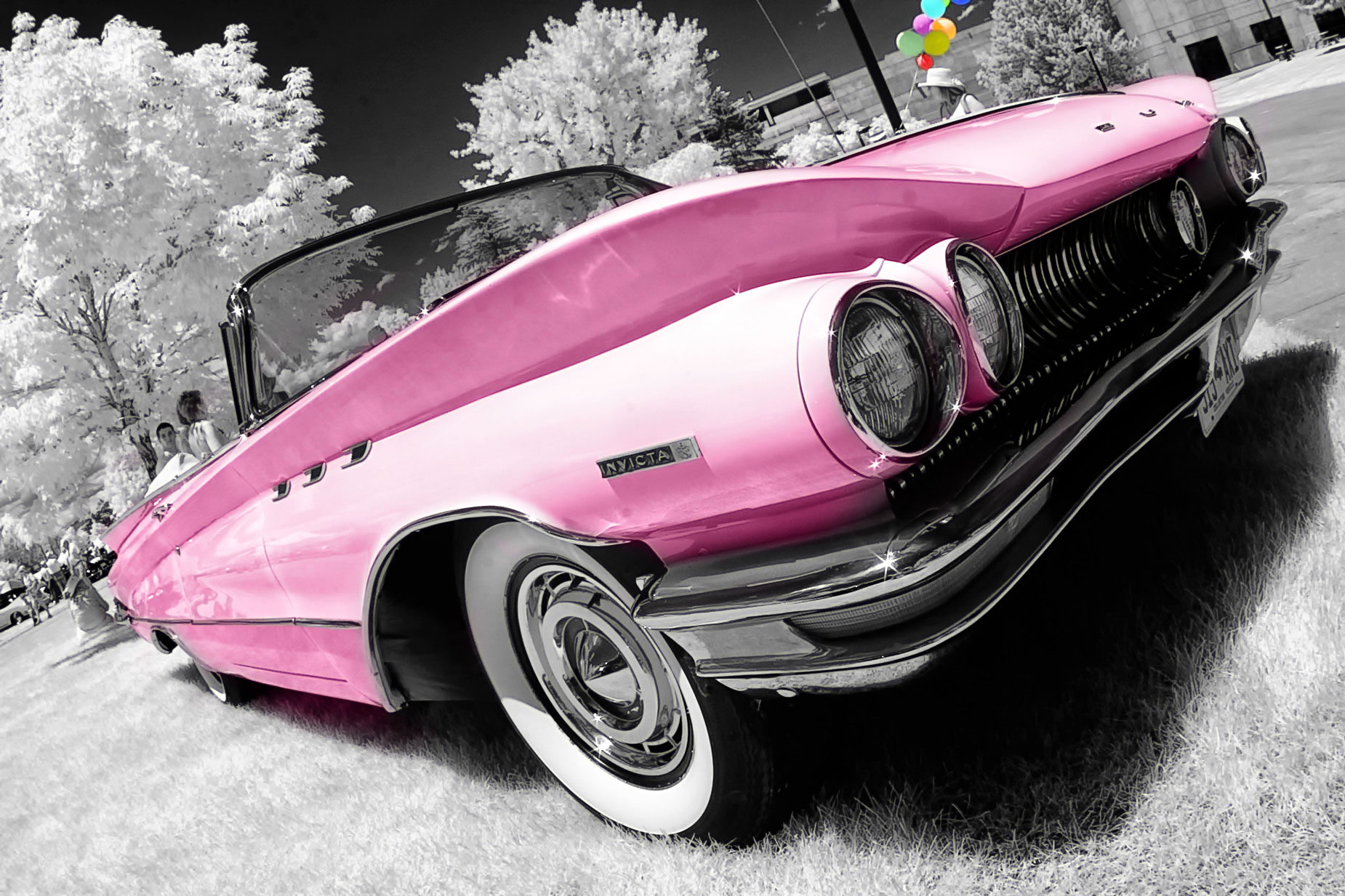
How I Made this Photograph: This image of a Buick Invicta convertible was made with Canon EOS D30 that had been converted for infrared capture using a 720nm filter conversion.. The lens was a 16mm f/2.8 manual focus Russian-made Zenitar that was purchased on eBay. It was focused using the Hyperfocal focusing technique that is explained in more detail here. The exposure was 1/60 at f/16 and ISO 299 with a plus on-third stop exposure compensatio.n. A black and white version of the RAW file was created with Silver Efex and had colored in Photoshop using techniques I explain here. See my post ‘My Love Affair with Buicks.
The Good Stuff About IR
Everyday scenes you might walk right by and never think of photographing, take on a completely new and sometimes dreamy look when captured in infrared. Landscapes may be considered to be the best or only subject matter for IR capture but there are other subjects worth investigating. While I think almost everything makes a great subject for digital infrared photography, here are a few possibilities:
- Landscapes: This is the classical infrared application because when captured in IR, tree leaves appear to be almost white and along with a black sky, the effect can be dramatic. This is a effect produced when photographing deciduous trees and grass because they reflect the sun’s infrared energy instead of absorbing it as evergreens do.
- Cars: Infrared images don’t have to be strictly black and white. I like to apply digital toning effects to some IR image files and used my IR-converted Canon DSLR to make the above shot that was digitally colored in Photoshop. I colored Mary’s balloons too.
- Architecture: For many years, professional architectural photographers used infrared film to make images of buildings. That’s partly because IR photography cuts through haze, adds contrast, and produces pure black skies to make photographs of buildings look even more dramatic.
- Portraits. In my infrared photography book (see below) I show a few portraits but one magazine editor rejected my infrared portraits because she thought it added a creepy “Twilight” look (vampires ya know?) to the images. If you’re careful, aren’t too close and have the subject looking off to the side, it shouldn’t bother you. If its does, it’s time to move onto other fun subjects, such as.
- Travel: There’s nothing new about black and white travel photography but adding an infrared capture option lets you capture some of your next travel images using invisible light.
- Macro: Even flowers. IR can add a new dimension and give you another tool in you utility belt for creating images that are, indeed, different looking.
And that, my friend, is what infrared digital imaging is all about: Having fun with photography no matter what subject you decide to photograph.
 I’ve found that Life Pixel does a great job with IR conversions and they’ve done most of the conversions for my Canon DSLRs and all of my Panasonic Lumix G-series cameras. This is not a paid or sponsored endorsement, just my experience.
Used copies of my book, The Complete Guide to Digital Infrared Photography are available from Amazon starting around nine bucks as I write this. My book Creative Digital Monochrome Effects has a chapter on IR photography and is available new from Amazon for $11.46 with used copies starting around six bucks as I write this.