
Today’s Post by Joe Farace
Cars are the sculptures of our everyday lives.–Chris Bangle
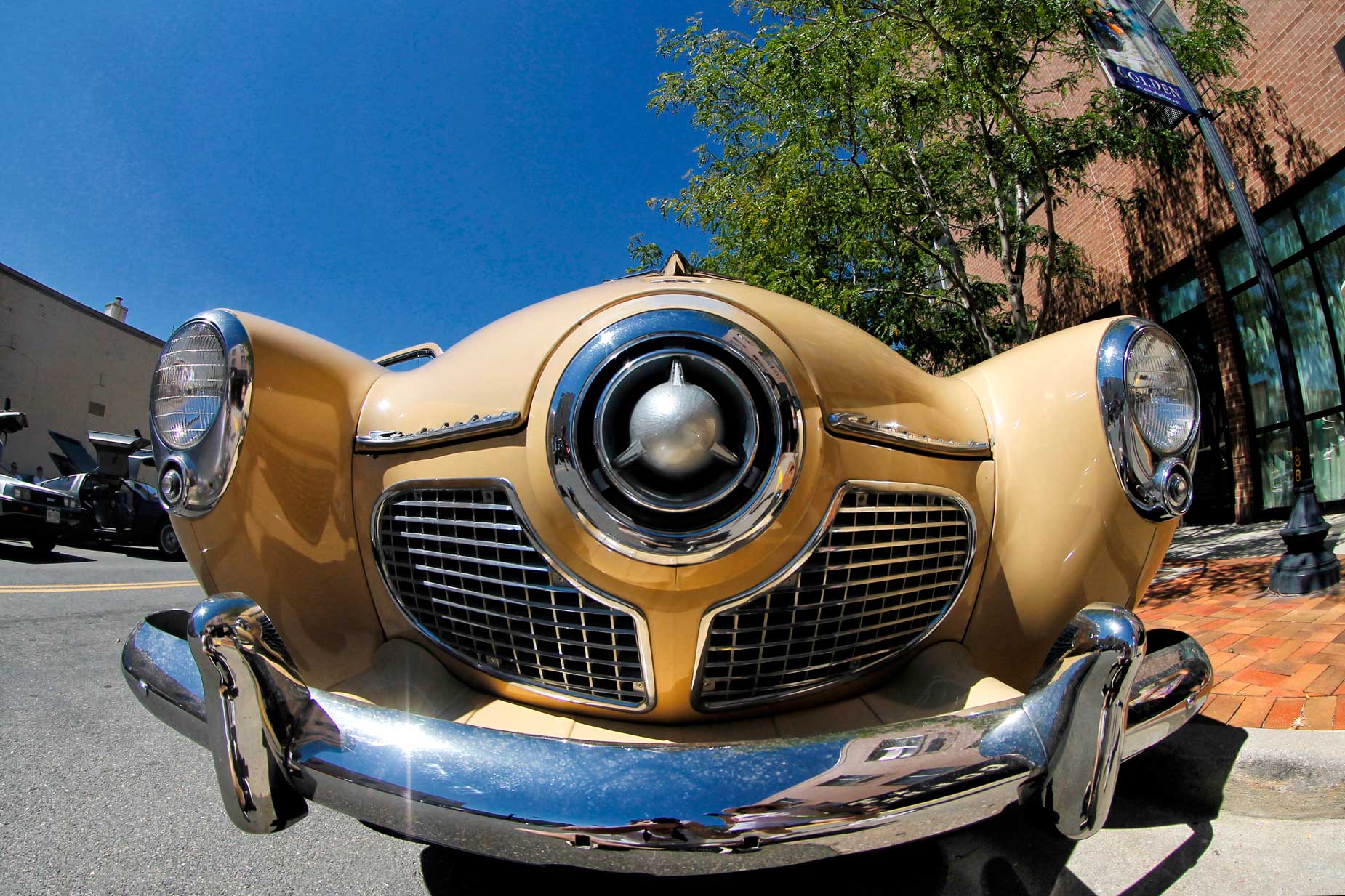
First a little history: The Bullet Nosed Studebaker models of 1950 and 1951 were designed by Raymond Loewy and are a favorite of my wife Mary. The bullet nose models were available in three models: the Champion, the Commander, and the Land Cruiser. I think the one featured below is a 1950 Champion but I could be wrong. Any Studie experts out there, please let me know what it is? If I’m wrong I’ll correct this post.
How I made this Photograph
Studebakers, like this bullet-nosed model, exert a strong pull on my automotive tastes. This particular Studebaker was photographed at an Orphan Car Shoe in Golden, Colorado that was part of their annual Buffalo Bill Festival. The camera used was a Canon EOS Digital Rebel T3 with an EF 8-15mm f/4L Fisheye USM lens.
 That lens is part of Canon L-series lens and offers an 180 degree angle-of-view at 8mm. To limit chromatic aberrations and color fringing, the optical design incorporates two ultra-low dispersion glass elements with a Sub Wavelength coating to control flare and ghosting. Fluorine coating was applied to the front element to resist fingerprints and smudges. Since, it’s an L-series lens, the EF 8-15mm f/4L Fisheye USM is sealed against dust and moisture on those occasions when you find yourself working in inclement environmental conditions. A built-in filter holder is located at the back of the lens and accepts cut gel filters, which is about the best you can expect with a front lens element shaped like this lens. The lens is designed for full-frame DSLRs but can be used with APS-C models, like the EOS Rebel T3 I used here, where it provides a 12.8-24mm equivalent field-of-view
This image was made when I was looking for a subject to show how the EF 8-15mm f/4L Fisheye USM lens exhibits a trace of vignetting when used with the (removable) lens hood in place, even when used with a 1.6 magnification factor camera such as the EOS Rebel T3. For this HDR image, I shot it at 9mm (14mm equivalent) so any vignetting was eliminated. Suggestion: To get the maximum coverage with the EF 8-15mm f/4L lens on a 1.6 multiplication factor camera, like the EOS Rebel T3, simply taking off the lens hood; that should eliminate any vignetting.
If you enjoyed today’s blog post and would like to buy Joe a cup of Earl Grey tea ($3.50), click here.