
Today’s Post by Joe Farace
“Mrs Joe was a very clean housekeeper, but had an exquisite art of making her cleanliness more uncomfortable and unacceptable than dirt itself. ― Great Expectations
One of Farace’s Laws is that “if you take care of your photo equipment, it will take care of you.” When cleaning lenses, for instance, you should not douse their front element with cleaning fluid. That stuff is highly viscous and can seep into your lens’s nooks and crannies and, with repeated use, create problems such as causing lens elements to separate, which is not a good thing, believe me. That’s why I’ve been using LensPens products to clean my lenses for more that 30 years. LensPens are not only useful but are small enough you can clip one in your shirt pocket or toss it into your camera bag or backpack.

How I made this photograph: The Colorado Railroad Museum is a picturesque place to make photographs but when the wind is blowing.can get a bit dusty. The featured image was shot with a Canon EOS 50D that had been converted to IR-only capture by Life Pixel using their Standard IR (720nm) filter. Infrared fans will notice the subdued Wood Effect, caused by fall leaves that were in the process of changing. The Tamron 28-300mm F/3.5-6.3 lens was at 31mm; The exposure was 1/100 sec at f/16 and ISO 400. The RAW file was opened in Photoshop then converted to Monochrome using Silver Efex before being Platinum toned in Photo Kit.
Which LensPen Should You Use?
Why not start with the DSLR-Pro Kit. It’s an affordable ($28.95) package that includes everything digital or film photographers need to keep their lenses, viewfinders and filters clean. Here’s what’s in the kit:
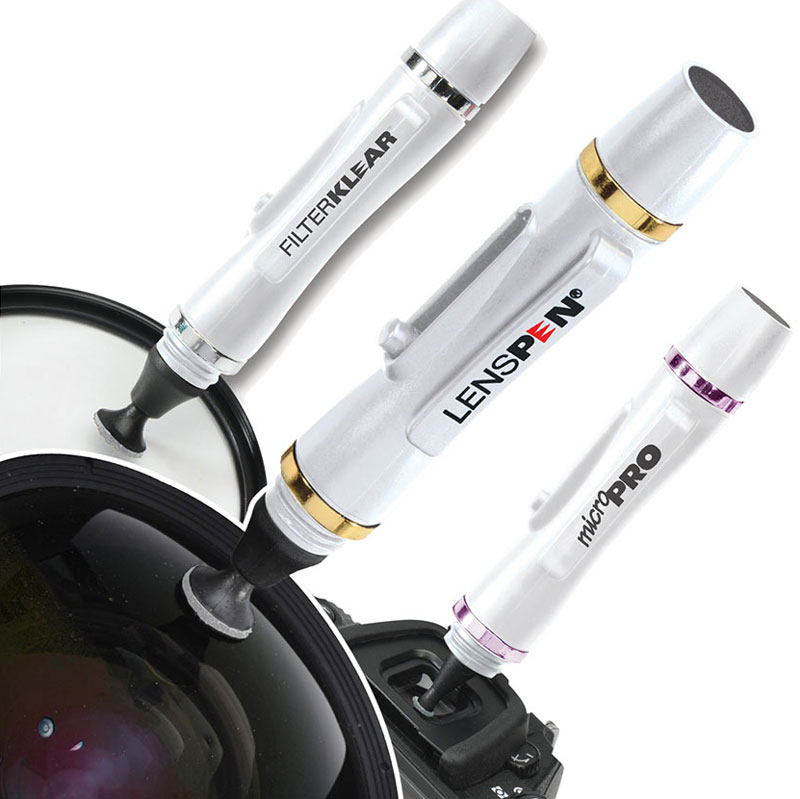 An original LensPen. This is a full size LensPen with a concave cleaning tip that matches the slightly convex shape of a camera lens. I use one of these to remove grease and fingerprints from lenses not just for my DSLRs but my mirrorless and film cameras too!
- The FilterKlear pen has a flat, round cleaning tip that’s designed to clean lens filters. This is something that’s really important for film shooters, since in addition to protection filters they tend to use more and different kinds of lens filters than digital shooters.
- The MicroPro is the smallest LensPen and will clean any viewfinder or other small optical surfaces. It has a smaller cleaning tip that’s useful for cleaning eyepieces and tiny lenses, such as my Keks Oreo lens that I wrote about here.
- The kit also includes a microfiber carrying pouch that doubles as a cloth for other kinds of cleaning applications, such as wiping down a camera body
Both the Original LensPen and it’s cousins will clean your optical surfaces in a few easy steps:
- First, Use the retractable, natural brush to remove any loose dust that’s sitting on the glass surface.
- Second, if smudges remain, simply twist the cap off and use smooth circular motions of the carbon-impregnated cleaning tip on the lens. If any smudges persist, breath on the lens and repeat.
- Third, you’re finished, now twist the cap back on.
LensPen’s twist-action cap is important because it re-charges the carbon compound on the cleaning tip and ensures that the cap won’t pop off in your pocket or camera bag, like my lens caps and camera eye cups tend to do.
LensPen products are environmentally friendly and safe to use. There’s no expiration date and they perform well in arctic cold and desert heat.
LensPen is a long-time sponsor of my sites and blogs and I’ve been using their products long before I had a blog. Mary bought me my first LensPen in 1994 when I acquired a Nikon N90s SLR! I would like to thank LensPen for their continued support.