
It’s #anythingcanhappenday and today’s post features a portrait of Tia Stoneman, who was, for all intents and purposes, my first Muse. She is also the model I photographed more times using infrared techniques than any other, although Erin comes in a close second.
Today’s Post by Joe Farace
In art, there is no need for color; I see only light and shade. Give me a crayon, and I will paint your portrait.–Francisco Goya (1746-1828)
Maybe if Goya was still alive he might have suggested infrared photography and not crayons. As I’ve mentioned here a few times, there really are no “official” subjects for digital IR photography. If you have time, please read Best Subjects for Infrared Photography on my car photography blog for some of my other thoughts on the subject.
I think my initial hesitancy to make infrared portraits was because along with some of my IR-shooting friends we’ve been told by “experts” that we should not photograph people using infrared techniques. This still appears to be a widely held opinion.
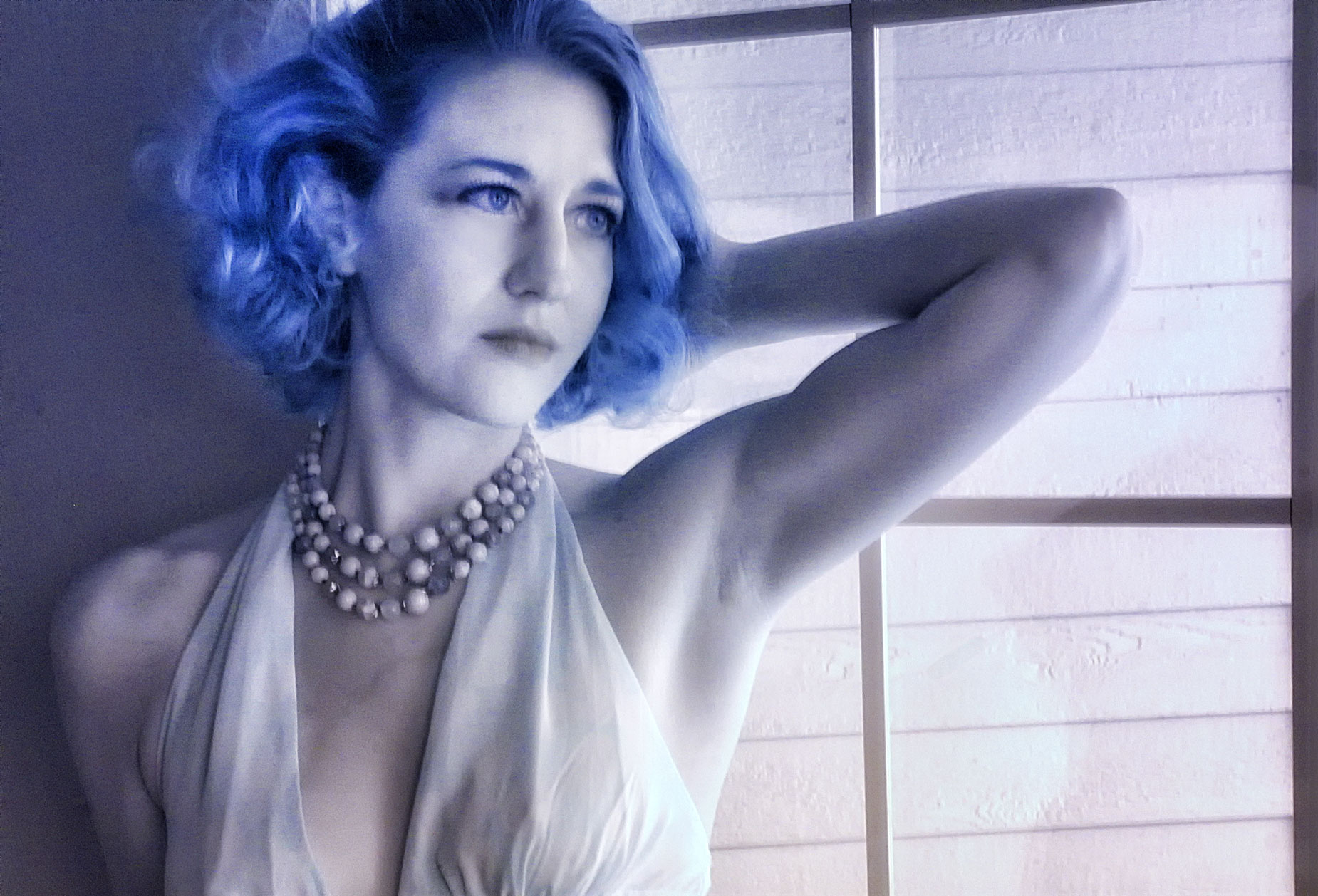
How I made this portrait: For many years I was lucky enough to photograph someone who was my first muse– the irrepressible Tia Stoneman. She was a delight to work with no matter what genres and styles we tried together, including this infrared portrait that was the first of three different infrared sessions we had together. Her hair is not blue but dyed red and this IR camera’s conversion turned it blue.
Tia was photographed using window light in the North light kitchen of my former home. The camera used was a Canon EOS D30 that was converted for infrared capture by a company no longer in business using a 87B (720nm) filter. The lens was an EF 28-105mm f/3.5-4.5 lens at 70mm. The exposure was 1/160 sec at f/5.6 and ISO 800 with a plus two-thirds stop exposure compensation. It was shot as a JPEG before I transitioned to RAW+JPEG capture. The file was first manipulated by using a 20% Multiply Opacity layer, then sharpening with Photoshop’s Smart Sharpen before applying a layer of Tonal Contrast from Color Efex before adding some selective Dodging to produce the result you see here.
Infrared Portraits are Not For everyone
When I submitted an infrared photograph of Tia for an article on infrared photography to an editor at a professional photography publication, the image was rejected. The editor’s reasoning was the subject looked too much like a vampire. It’s a different look for sure and one that some may like, while others may not. An infrared photo of Tia was got cut from my book, Available Light Glamour Photography by its publisher. A different editor wasn’t a fan of it either, though they never explained why.
There are a three reasons why having an infrared option for some boudoir and glamour portraits is something you might want to make:
- Aesthetics: Sometimes you need to produce an image that looks different from the last portrait you made; Infrared photography should do the trick because the post-processing options are almost infinite.
- Workflow: There are also many ways to use software and Photoshop plug-ins to produce great looking image images from RAW or JPEG files. I even wrote a book that included some thoughts on this subject called Creative Digital Monochrome Effects.
- Feedback: Perhaps the best reason to shoot in infrared is the feedback the subject will give when looking at an IR mage on the camera’s LCD screen. Yiou get to show your subject what you’re trying to accomplish or how you’ll convert the shot into monochrome or whatever later; it’s already there! They will either love it or hate it but at least you’ll know how the session is going and can react accordingly.
 I’ve found that Life Pixel does a great job with IR conversions and they’ve done conversions for some of my Canon DSLRs and all of my Panasonic Lumix G-series mirrorless cameras. This is not a paid or sponsored endorsement, just my experience.
New copies of my book, The Complete Guide to Digital Infrared Photography are available from Amazon for $43.65, with used copies selling for around nine bucks, as I write this. New copies of my book Creative Digital Monochrome Effects that has a chapter on IR photography are $13.78 with used copies selling for around seven bucks, as I write this.