
If you’ve been reading the blog for a while and watching Barry Staver on our Pixels, Grain & Cookies Podcast, you know I have a fascination with cameras with CCD sensors.Today’s post features an image made with the Konica Minolta diMage x1 that had a CCD sensor.
Today’s Post by Joe Farace
“There is a certain enthusiasm in liberty, that makes human nature rise above itself, in acts of bravery and heroism.”—Alexander Hamilton
For those readers living outside the USA: Veterans Day is an American holiday that honors our armed service veterans and is observed on November 11th.
Veterans Day coincides with the Armistice Day or Remembrance Day holidays that are celebrated in other parts of the world and marks the anniversary of the signing of the armistice that ended World War I. Major hostilities of WW 1 formally ended on the 11th hour of the 11th day of the 11th month of 1918 with the signing of the armistice at Le Francport near Compiègne, France that ended fighting on land, sea, and air.
Veterans Day is different from Memorial Day, which is day for remembering members of the U.S. military who fought and died while in service.and is observed on the last Monday of May. Veterans Day commemorates the service of all U.S. military veterans, including my Dad who fought for our country during World War 2.
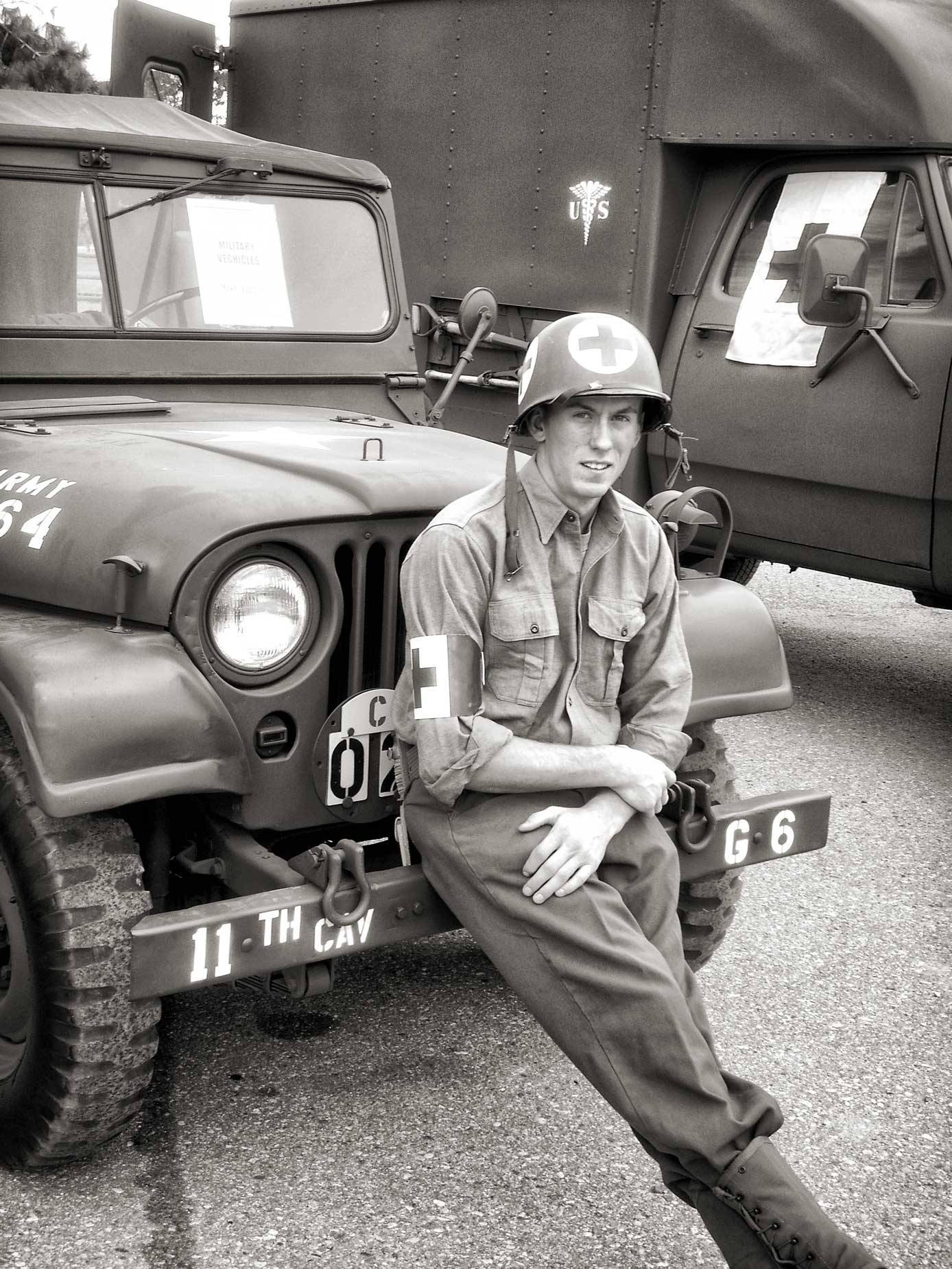 How I Made this photograph: The camera used to make this images was an eight-megapixel Konica Minolta diMage x1 that had a 7.144 x 5.358mm CCD sensor. The main difference between a CCD (Charge-Coupled Device) and a CMOS (Complementary Metal-Oxide-Semiconductor) camera sensor is how they capture light and turn it into electrons Their internal architecture and performance traits differ significantly, so much so that some (many) photographers believe that cameras using a CCD sensor produce a more film-like image file. While this particular camera’s sensor is physically small, its image quality is surprisingly good.
This photograph was made during a car show at the Adams County Historical Society’s outdoor museum near Brighton, Colorado. The camera’s lens was a 37-111mm (equivalent) f/3.5-3.8 at 48mm and the exposure was 1/100 sec at f/3.5 and ISO 50. The image was captured in color but converted to black and white with Silver Efex and warm-toned in PhotoKit to make it look as if it could have been made in 1944.
The Battle of the Bulge
It happened on a Snowy day in 1944 in the Ardennes Forest near the German and Belgium borders. The “Battle of the Bulge,” also known as the Ardennes Counteroffensive, was a massive military operation that was undertaken by Nazi Germany and lasted from December 16, 1944 until January 25, 1945. The intent of the offensive was to split the Western Allies ground forces from one another and encourage them to make peace with Germany.
During this battle more than one million soldiers, including 500,000 Germans, 55,000 British and 600,000 Americans, were engaged in combat, including my father who was a PFC in a machine gun squad. It was an Army medic, looking much like this young man, who pulled my Dad out of a mortar crater where he had been wounded by shrapnel and patched him up so he could return home after the war to my mother, sisters and me.
This photograph is an homage to all the brave men and women of our armed forces and especially my late father Joseph F Farace Sr. (1918-2004) who was awarded the Bronze Star and Purple Heart for his actions during The Battle of the Bulge.