
In addition to being National Photo Month, May is also the wettest month of the year for Colorado, averaging 2.16 inches of rainfall, due to a convergence of weather patterns that are unique to this time of year. These two distinct weather systems coincide, creating ideal conditions for significant moisture. While I’m thinking about creating a #wetwednesday series, the Film Friday post are on hiatus.
Today’s Post by Joe Farace
“A photographic portrait is a picture of someone who knows [that] he is being photographed.”—Richard Avedon
The above quote demonstrates that the late Mr. Avedon was not only was a genius behind the camera but was perceptive about his photographs and what they represented. The truth is that a portrait seldom represents reality. Instead it’s an image of a person at a specific point in time that though posing and retouching presents an idealized version of someone who knows they’re being photographed.
Take posing for example
The point of any pose is not just to look natural, although that certainly is an objective for some photographers but perhaps it’s also to tell a story and there are many ways you can pursue that goal, which may have been the thought process behind today’s featured image..
Some photographers prefer to keep their posing subtle, while others are not so restrained. One possibly apocryphal story is that Yousuf Karsh’s famous portrait of Winston Churchill was made during a two-minute session in which Karsh gently and politely removed the ever-present cigar from Churchill’s mouth to produce the determined look you see in the finished photograph.
No matter how you achieve the pose, the creative portrait experience starts with experience, observation along with communication with the subject. In all of the various posts that I’ve made here over the years about posing, I try to help with the latter two aspects but the first one is up to you because as the punchline to an old joke goes, the best way to get to Carnegie Hall is “practice, practice, practice.”
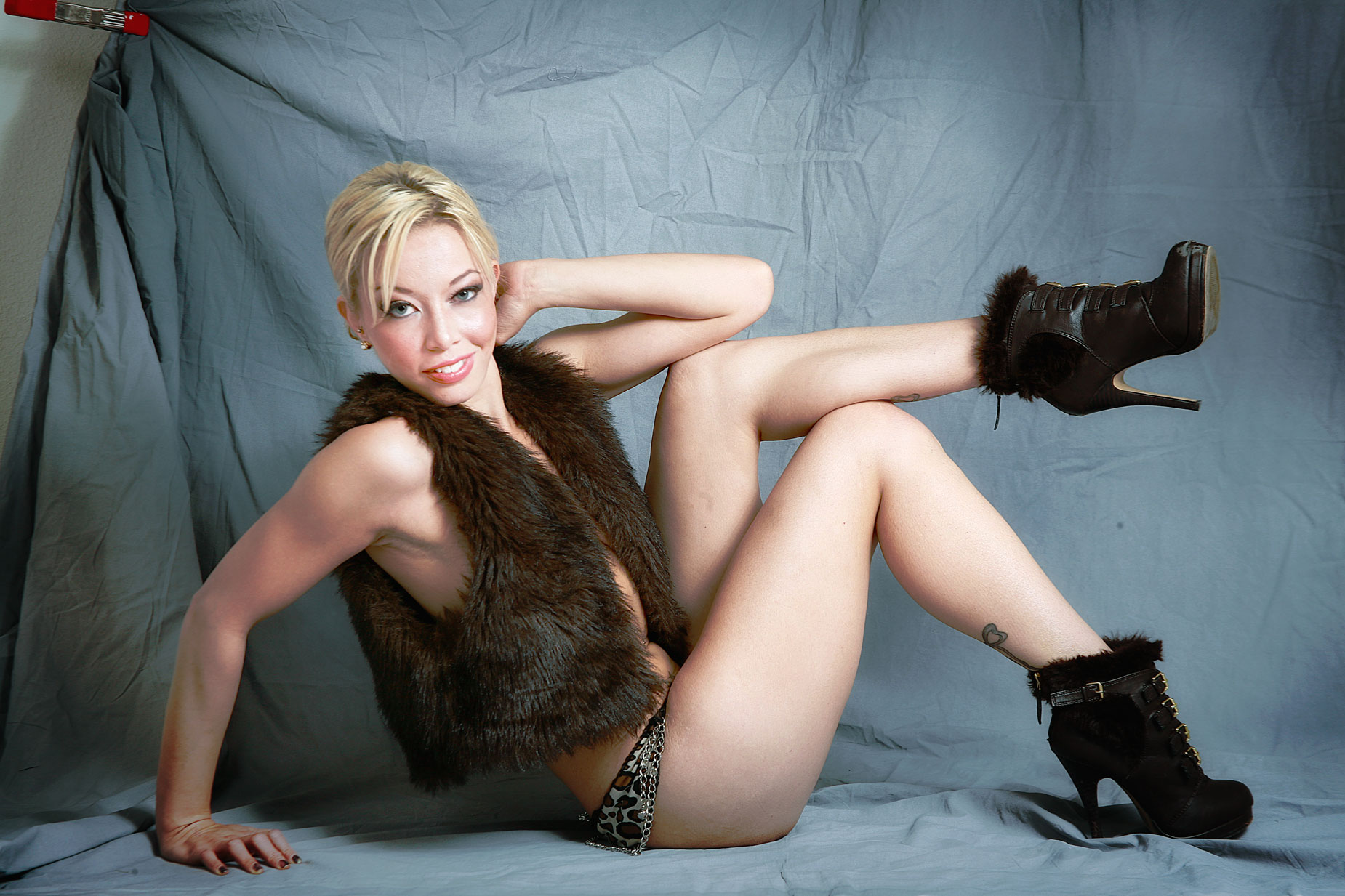
How I made this portrait: Misa Lynn’s furry outfit looks oh-so retro (think Sonny and Cher.) Lighting was from a Speedotron Brown Line M11 light head with 48-inch black-backed silver umbrella that was placed at camera right with another Speedotron Brown Line M11 head with 54-inch silver umbrella mounted that was located near the back of my studio at studio left. Output power was set at 400 Ws with the power pack in Symmetrical mode producing a final exposure of 1/125 sec at f/13 at ISO 100 with a Canon EOS 5D Mark I and EF 28-135mm f/3.5-5.6 IS lens (at 90mm.)
When working with any kind of studio flash system you’re eventually going to encounter this buzzword: lighting ratio. Lighting ratio is the difference in the brightness in the light that’s falling on your subject between the main or key light and the fill light but there can also be tertiary lights that serve other purposes such as adding highlights to the subject’s hair or illuminating the background. Understanding this concept can be important when working with power packs that offer asymmetric controls that can be set for different output intensities. A lighting ratio of 3:1 is considered “normal” for color photography but I strongly believe that photographers can be flexible in applying this rule and to tell the truth I seldom worry about it.
 If you enjoyed today’s post and would like to support this blog, you can help by joining my Patreon, where memberships start at just $1.25 a month, with additional levels of support at $2.50 and $5 that include special benefits. If you do, I would like to thank you for your support.
If you’re interested in learning how I use cameras, lenses and lighting in my in-home studio and on location, please pick up a copy of Studio Lighting Anywhere which is available used from Amazon.com for less than ten bucks, as I write this. The Kindle version is $19.99 for those preferring a digital format.