
If you haven’t already seen my other take on photographic composition, click this link before or after reading today’s post.
Today’s Rant by Joe Farace
No one is an artist unless he carries his picture in his head before painting it, and is sure of his method and composition. —Claude Monet
Edward Weston once said, “consulting the rules of composition before taking a photograph is like consulting the laws of gravity before going for a walk.” And I couldn’t agree with that statement more. Recently, when a friend of mine was trying to offer a young photographer some constructive criticism about their work, the young shooter told him, “I Don’t Do Composition.” But…
…I hate to be the one to break it to that guy but the instant you place a viewfinder to your eye, look at an EVF or a flip-out screen, every visual choice you make affects the photograph’s composition. Of course, they may be bad choices but there you have it.
It’s All About Composition

How I Made this Photograph: Mission San Francisco de Asís in Rancho Taos is a National Historic Landmark and is a beautiful adobe church that was built in the early 1800s. The church is still active today. I made this image when Mary and I were visiting friends in Taos,using my wife’s four-megapixel Canon PowerShot SD10 (that she still has) proving it’s the “camera you have with you” that will let you make photographs.
Artists have always made conscious choices affecting the composition of their work. I’m sure Jackson Pollack was aware of the composition of his abstract expressionist paintings. As was Picasso or Salvador Dali with their surrealist art, let alone photographers like Ansel Adams. Any ennui this young photographer referred to earlier exhibited, I believe, was caused by the fact that throughout photography’s history, there has been so much written about the “rules of composition.”
In my opinion, there are no “rules” about photographic composition. My advice: Just keep making pictures!
One of the best books about photographic composition I’ve read is The Command to Look by William Mortensen that was originally published in 1937. The recent 2014 reprint is out of print but copies are available from all the used book sources and it’s a book that, I think, belongs in the library of everyone who’ serious about photography. Bargain hunters will note that used copies of the book are, sadly, not the good deals they once were.
Inside the pages of The Command to Look you won’t find anything remotely like the ‘rule of thirds’ that d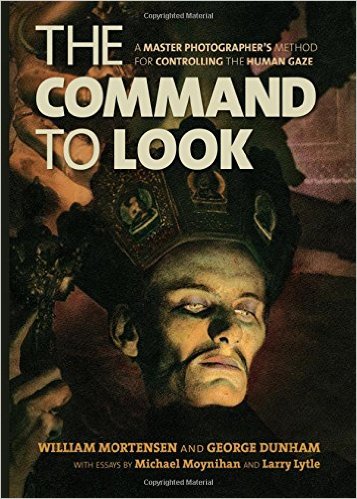 ivides an image into three slices and dictates specific intersection points where subjects should be placed for maximum impact. Nope, Mortensen applies a psychological approach to photography and as I’m reading the book for the third time I find that some of his comments have a subliminal “if you want your pictures to look like mine” component to them. Nevertheless, this is a fascinating way of approaching the subject of composition. The book is not an easy read and the reprint (only) includes a bizarre Afterward, so please read my review before purchasing a copy.
My personal philosophy of composition is based how a person looks at a photograph. Your eyes are attracted to the various components within an image in the following sequential order: sharpness, brightness, and warmth. On the simplest level, if the subject of the photograph is the sharpest, brightest, warmest object in the image, you’ve got a winner but if the subject is not sharp—tilt! The same thing happens when a sharp object is placed near a bright and warm object; you’re eyes are gonna ant to jump to that warmest object, whether it’s sharp or not.
Surprisingly I find that some of this same approach can be found buried inside some of Mortensen’s writing, even though most of his work is in monochrome.
So waddaya do? You really can’t say, “I don’t do composition…” because like it or not the second you press the shutter you are doing just that.
If you liked today’s blog post and would like to treat me to a cup of Earl Grey tea ($2.50), please click here. And if you do, thanks so much.