
In the original (1939) film of The Wizard of Oz, a dance number called “The Jitterbug” features some twisted looking trees and is a famous deleted sequence that involves a enchanted insect that’s sent by the Wicked Witch of the West to force Dorothy and her friends to dance until they collapse. Traces of the sequence remain and you can see some of it on YouTube.
Today’s Post by Joe Farace
“It is an illusion that photos are made with the camera… they are made with the eye, heart and head.”— Henri Cartier-Bresson
 I’ve always believed that the essence of a photograph is all about its lighting but infrared photography is different. This genre is all about capturing an image using invisible light, which is why it’s challenging to make direct comparisons between IR and traditional photography techniques. But let’s try…
You Want Some Drama?
If you want to create a dramatic image, few things beat photographing a beautiful sunrise in vibrant colors. Yet, if that same scene was photographed with an infrared filter or IR-converted camera , the results may be disappointing unless there is some IR reflective subject matter to add interest to the scene. That’s because the Wood Effect (bright to white reproduction of the chlorophyll layer of deciduous plants in black-and-white IR images) appears strongest at low sun levels. Interestingly, the effect is named after infrared photography pioneer Robert W. Wood (1868-1955) and not after the material wood, which does not strongly reflect infrared.
Tip: The needles of vergreen trees, such as the Ponderosa Pines that abound here on Daisy Hill, don’t reflect as much infrared light as deciduous tree leaves but depending on conditions and time of day may reflect some (but not all) of the IR light.
 Don’t confine yourself to landscapes. Here’s one of Farace’s Laws about capturing infrared photographs: If the lighting looks great for standard photographs, such as portraits in the shade or landscapes at sunrise and sunset, it’s probably not that great for infrared photography. Don’t just take my word for it; you should experiment because you never know for sure what the results will be when working in the infrared idiom until you try. For example, shooting an approaching storm often makes a great standard photograph but I have a feeling that it could also make a dramatic digital infrared image as well. Any trees in the scene should retain some IR reflectance and the storm clouds should add impact, right? It’s really anybody’s guess until you try, no matter what Yoda says.
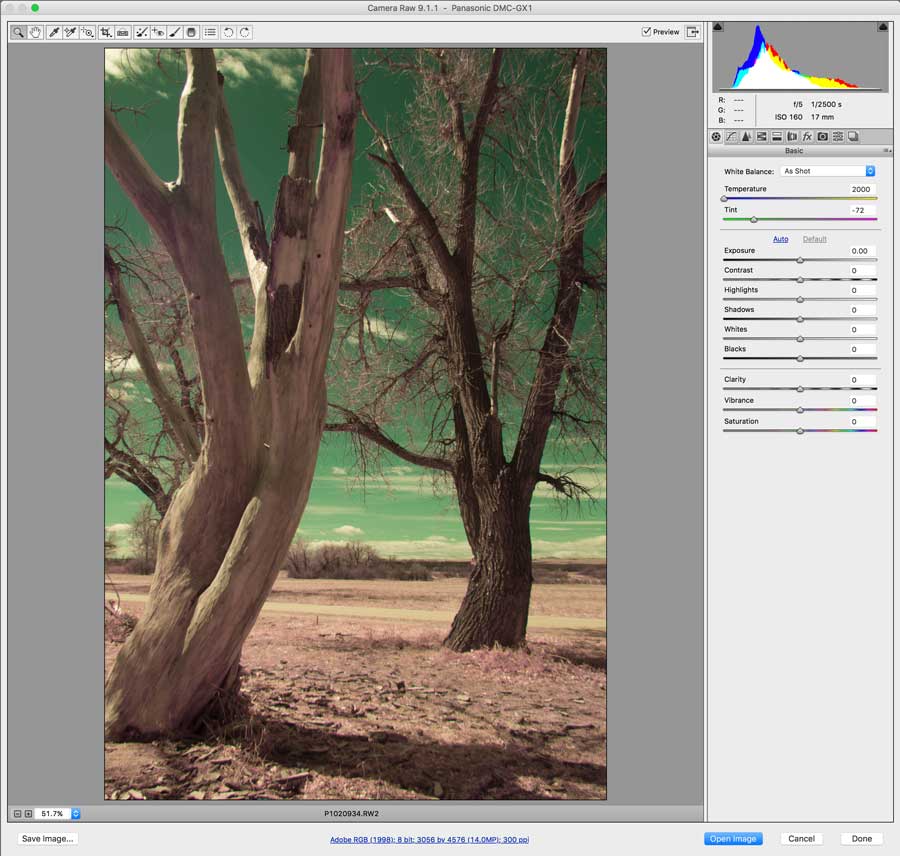
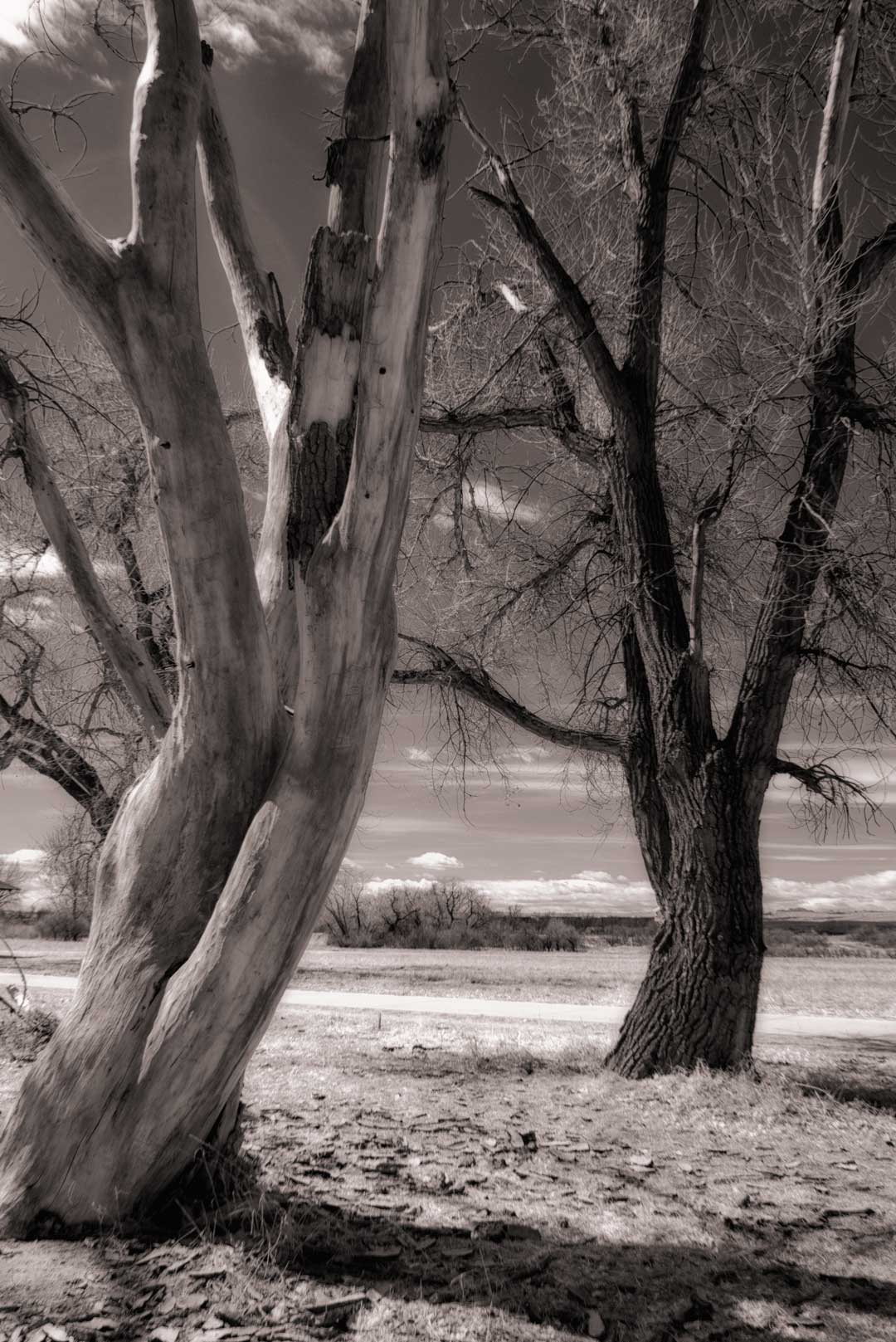
How I made this photograph: This is my take on “jitterbug” trees: I made the featured image at McCabe Meadows with the Panasonic Lumix GX-1 I purchased used from Used Photo Pro and was converted by Life Pixel using their Hyper Color filter. The lens used was the Olympus M.17mm f/2.8. The photograph was captured in RAW+JPEG mode. You can see the RAW file in the Adobe Camera RAW screenshot at above right. The Program mode exposure was 1/2500 sec at f/5 at ISO 160. After a some tweaking in Photoshop’s Levels I applied an action from a set that was part of a package that, at one time, was offered by Life Pixel for purchasers of their conversions. It was “Action1” that turned the color IR image into a moody monochrome one. No leaves; no Wood Effect.
There are no ‘official’ subjects for digital IR photography. Sure, summer landscapes with leafy deciduous trees, lots of grass, and puffy clouds make for a great infrared picture. Yet, some of the artists who are profiled in my book, The Complete Guide to Digital Infrared Photography, like to photograph people in IR and I do that myself from time to time. You can see some of my infrared portraits here and while I sometime shoot cars in infrared, much of my IR photography has been in the landscape idiom and most of the time it relates to landscapes located in my own neighborhood like this one.
 I’ve found that Life Pixel does a great job with IR conversions and they’ve done some of the conversions for my Canon DSLRs and all of my Panasonic Lumix G-series cameras. This is not a paid or sponsored endorsement, just my experience.
New copies of my book, The Complete Guide to Digital Infrared Photography are available from Amazon for $38.79, with used copies selling for around eight bucks, as I write this. New copes of my book Creative Digital Monochrome Effects that has a chapter on IR photography are available from Amazon for $38.79. with used copies also selling for around eight bucks, as I write this.