
Today is #anythingcanhappenday on the Blog. Lately, I’ve increased the number of portrait-related posts on the blog and based on the reaction, people seem to be enjoying them. This is a genre that I’m passionate about and was the subject of my four most recent books.
Today’s Post by Joe Farace
“We are often taught to look for the beauty in all things, so in finding it, the layman asks the philosopher while the philosopher asks the photographer.” — Killosophy
 Over the years, I’ve written several posts about the different kinds of approaches I’ve used for finding models. You can find any of the posts on this subject by using this site’s search feature–the magnifying glass icon–and entering “finding models.” A few people asked me to write an eBook on this subject and if there is any interest in it, maybe I will.
What Happens Next?
What happens after I find a new model who wants to work with me? With models I haven’t photographed before, I have an informal interview at a nearby Starbucks to look at her portfolio (if she has one) and if she isn’t familiar with my work, I show her the kind of photographs I create, so there are no surprises when we finally shoot together. This exchange helps establish rapport with the model.
Next, I like to schedule a test shoot to see how we like working together. A test shoot in my home studio or on location typically takes about two hours, at which time I’ll make approximately two hundred photographs. During the shoot, I’ll make both color and direct black and white images and the model will receive their choice of a CD or a flash drive containing all the photographs that we make during the session. These images are handed to them at the completion of the shoot to take with them.
 I don’t have any formula for posing when working with the model during a test shoot. A lot depends on her wardrobe choices and whether we’re shooting in the studio or outdoors. During the shoot, I’ll let them do their own thing, which helps show off their creativity and how I’ll work with her to create images we’ll both like. During the shot, I try to accent a model’s good points and minimize the ones she may be self-conscious about, even if I think she’s wrong about them. For example, one model told me, her boyfriend said she “had a big butt”; She did not.
I tell each model, and wholeheartedly believe it to be true, that I want to make them look as beautiful as possible. I one had a model tell me she liked how I photographed her because “I made her look pretty.” That’s also my goal during a test shoot; I want to create photographs that make the model happy and help us build a longstanding partnership.
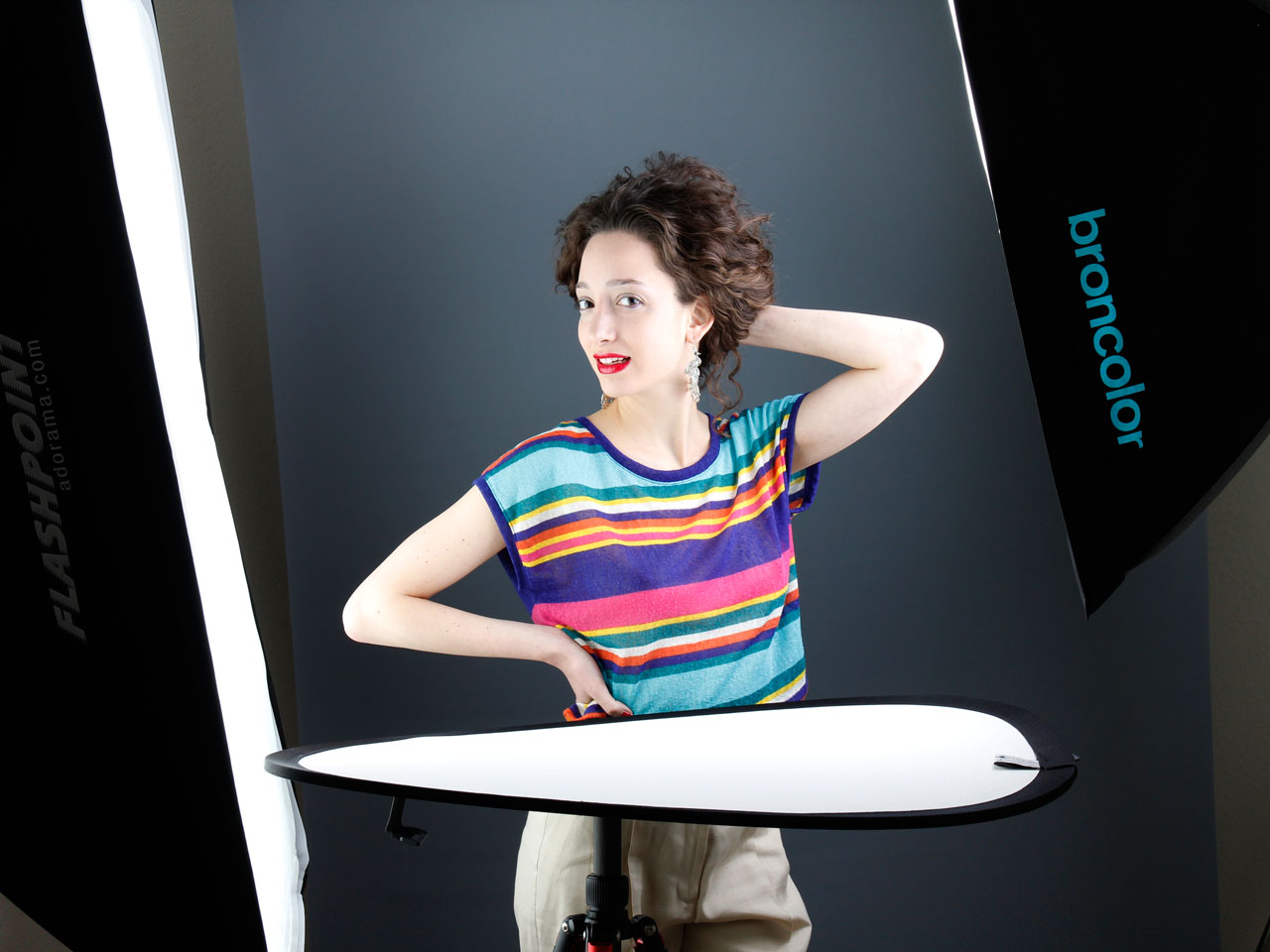
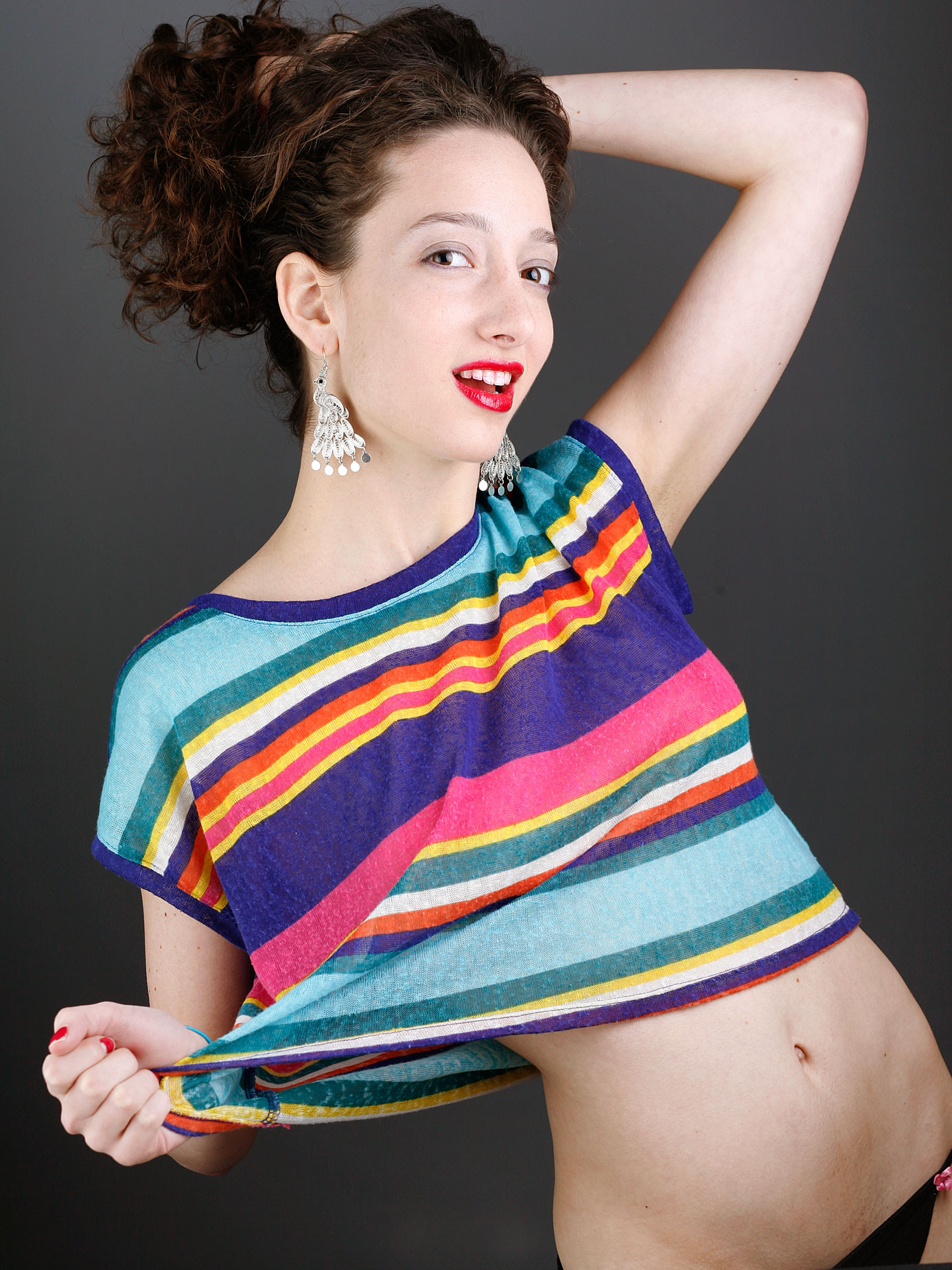
How I made this portrait: This fun headshot of aspiring model Laura May Bachmayer was made wit lighting provided by a Bron Move L power pack and head system with the simplest of lighting setups. The main light used a Bron MobiLED head with 28×28-inch (71x71cm) Bron soft box that was placed at camera right while a second Bron MobiLED head, with a 3.9×5.9-foot (120×180 cm) Bron soft box attached was located behind her and aimed at the subject’s side. In front of the model and reflecting light under Laura May’s chin, there was a 32-inch white reflector mounted on a tripod, as shown in the above right setup shot, that’s a substitute for a posing table I don’t own.
The background was a 5×7-foot (1.5x2m) Savage Grey Infinity vinyl backdrop suspended from JTL background stands. The camera used was a Canon EOS 5D Mark I with my favorite lens for headshots, the EF 85mm f/1.8 lens producing an exposure of 1/100 sec at f/9 and ISO 200.
My favorite part of this story is that if you look at that lighting setup photo, you will see a causal pose of a sweet young women but if you look at the finished image at left, you’ll see a portrait of a dynamic and beautiful woman. I think it was Mandrake the Magician who once said, “It’s all done with lighting” and he was partially right. The other part is the attitude that a talented model can bring to any shoot, even for a headshot like this one.
 In addition to the featured portrait, this session with Laura May Bachmayer included some uncensored images that members of my Patreon got to see in a Bonus Password Protected post. You can read about membership benefits in this post.
My book Joe Farace’s Glamour Photography is full of tips, tools and techniques for glamour photography and includes information on all of the cameras I used as well as complete lighting and exposure data for each image. Used books are available from Amazon for $33.17, I write this. The Kindle version is $19.99 for those preferring a digital format.