
Today’s Post by Joe Farace
…everything around us, dead or alive, in the eyes of a crazy photographer mysteriously takes on many variations, so that a seemingly dead object comes to life through light or by its surroundings… To capture some of this – I suppose that’s lyricism.—Josef Sudek
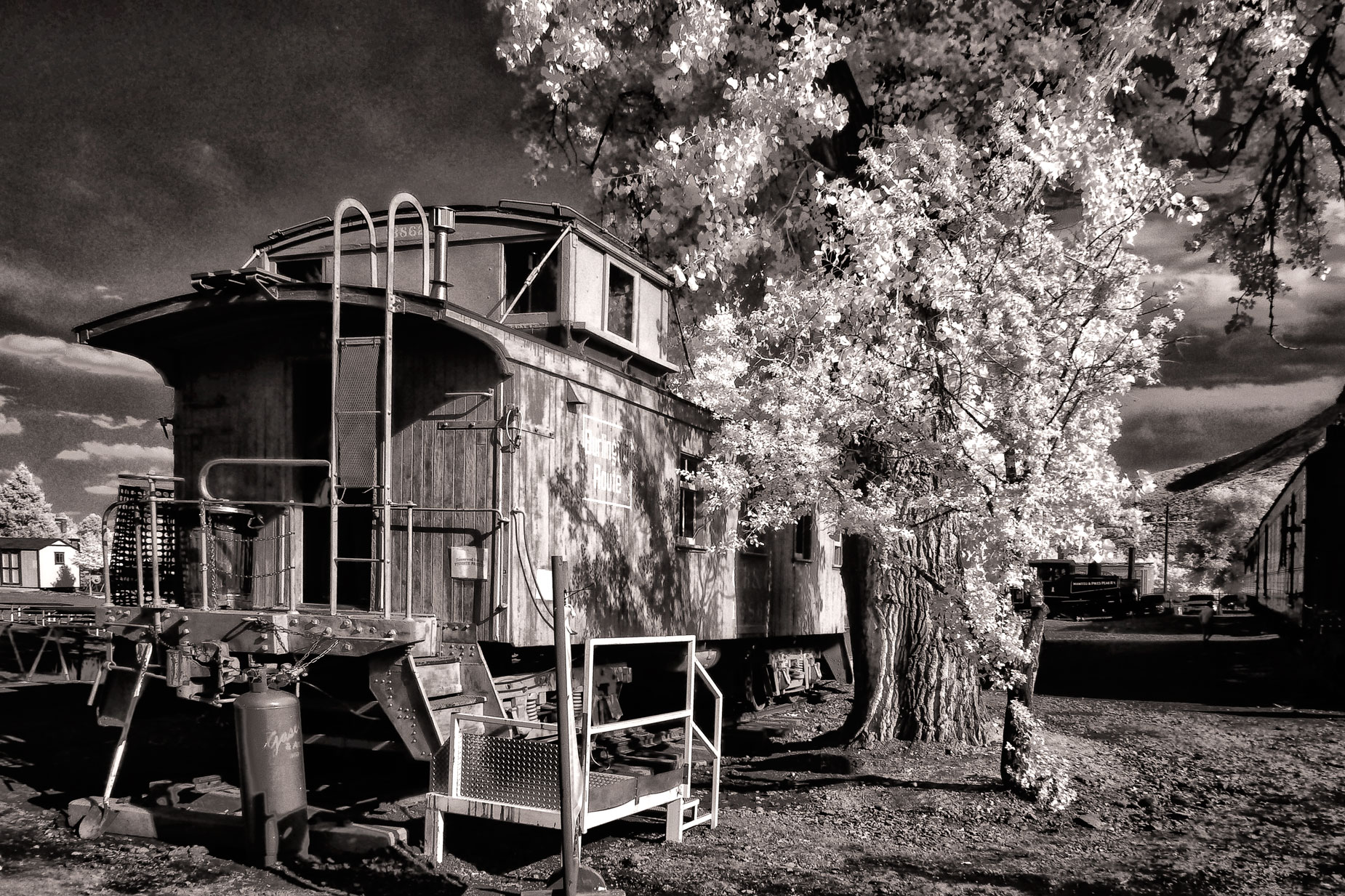
I made the be;ow composite infrared photograph at the Colorado Railroad Museum in Golden, Colorado, one of my favorite places to shoot and not just for infrared images. In the late 1940s when Colorado’s narrow gauge railroad companies began going out of business, Robert W. Richardson started collecting rolling stock, railway records, and other pieces of equipment to preserve Colorado’s railroad history. Bob’s collection outgrew the space at his Alamosa Museum and in 1958, with the help of Cornelius Hauck, Richardson moved the Museum to Golden, Colorado. In 1964, the nonprofit Colorado Railroad Historical Foundation was formed to assume ownership and operation of the Museum. Its mission is dedicated to preserving for future generations a tangible record of Colorado’s dynamic railroad era and particularly its pioneering, narrow gauge mountain railroads.
How I Made this Photograph
Josef Sudek (1896 – 1976) was a Czech photographer, best known for his photographs of Prague. Before the first world war he trained as a bookbinder and was an amateur photographer. Despite having only one arm, he used large, bulky cameras, sometimes with the aid of an assistant. Sudek’s photography is sometimes said to be modernist but this seems to be only true of several years during the 1930s; Primarily, his personal photography is neo-romantic. That’s a style that was applied to writers, painters, and composers who rejected, abandoned, or opposed realism or avant-garde modernism and has existed from 1840 down to the present time and in many ways describes some—many?—of my own (non-portrait) photographic sensibilities.
 As I mentioned in the first paragraph, this image does not represent a single photograph but instead is a composite of three different infrared RAW files that were made at the same time. On this particular day, this caboose was being used for a children’s party with kids and their parents running in and out of it during all of the time I was there. I really just wanted to get just a shot of the caboose and the tree but wasn’t sure how IR images of people and kids in the scene would affect the mood I was trying to create. I tried waiting for the activity to settle down and just kept shooting hoping to get an image without birthday celebrants running around. But that never happened.
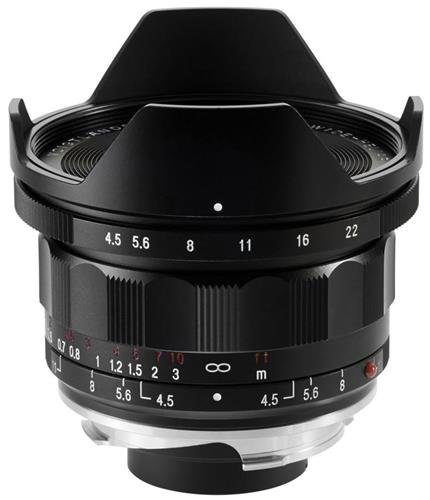
I shot all of the images using a Panasonic Lumix G5 that was converted for infrared use by LifePixel using their Standard IR (720nm) filter. The lens used was a borrowed Voigtlander Super Wide Heliar 15mm f/4.5 M Mount Aspherical III lens that was attached to the camera using a $23.95 Fotodiox Leica M to Micro Four-thirds adapter. All of the RAW files were captured using a nominal exposure of 1/250 sec at f/11 and ISO 400.
To create the final image, I used Photoshop’s Layers function, combining three or four (I don’t remember) different RAW image files that had different people located in different places within the frame and then selectively erased the areas that had people in them to produce the final image. After compositing, the completed image file was processed in Silver Efex then toned using the Platinum toning option in PhotoKit 2. The final result, to my mind anyway, was inspired by and is an homage to the wok of Josef Sudek.
 I’ve found that Life Pixel does a great job with IR conversions and they’ve done some of the conversions for my Canon DSLRs and all of my Panasonic Lumix G-series cameras. This is not a paid or sponsored endorsement, just my experience.
New copies of my book, The Complete Guide to Digital Infrared Photography are available from Amazon for $44.59 with used copies starting around eight bucks as I write this. My book Creative Digital Monochrome Effects has a chapter on IR photography and is available new from Amazon for $11.46 with used copies starting around eight bucks as I write this.