
It’s #monochromemonday and it’s also National Star Wars Day (“May the Fourth Be With You”), and this year I’m skipping the annual photo of me being accosted by the Empire’s storm troopers to post an image, that’s in color, monochrome and infrared!
Today’s Post by Joe Farace
As a wise man once said, “It won’t be long now…”
Although Spring may have already sprung where you live, real Spring in Colorado seems just around the corner. The temperature when I got up this morning was 37 degrees F ( three degrees C,) so it was chilly. For me that means it’s getting close to time for infrared photography, although I’ve been playing around with it a little during this winter.
If you’ve even wondered what a scene looks when photographed in color, then baklck and white and then monochrome infrared, your wait it over. It’s all there below…
Thoughts of Infrared Springs Eternal
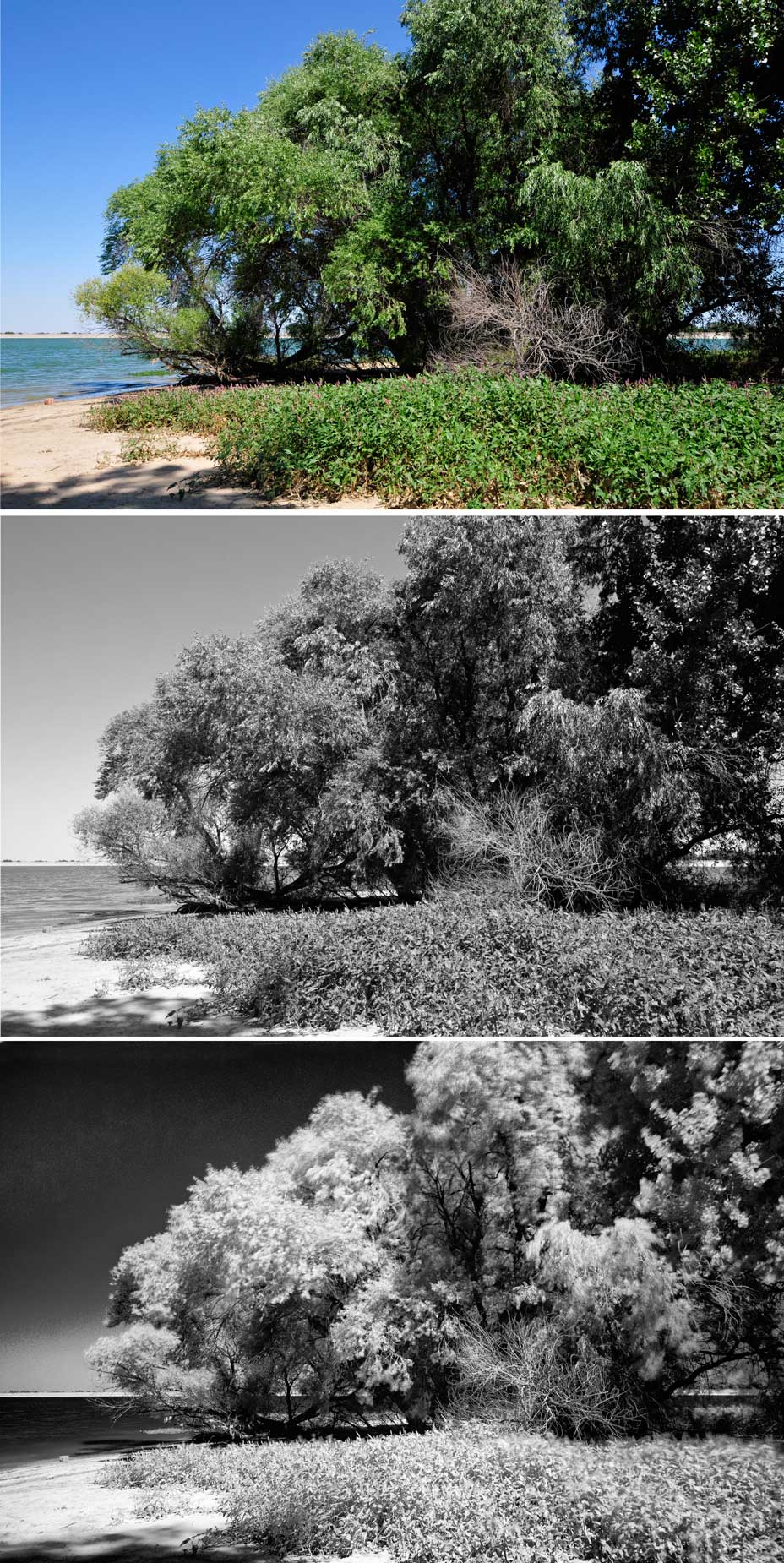 How I Made these images: This series of shots shows the digital infrared capabilities of a Nikon D300s DSLR. The top color shot was made with a Program exposure of 1/400 sec at f/10 and ISO 400 in the camera’s Vivid Color mode that pretty much matched what my eyes saw through the Sigma 10-20mm f/3.5 EX DC HSM lens. The middle image received the same exposure with the camera set for Monochrome capture. The third and bottom photo was made after a series of exposures through an A-series Cokin 89B (720nm) from my IR filter kit (see below) that was held in front of the lens with my fingers. The lens hood was removed so the filter could be held flat against the front of the lens. The Manual exposure was eight seconds at f/8 and ISO 400. When you compare this infrared image to the others it seems to have more dimensionality to it. What do you think?
What’s in My IR Filter Kit?
From time to time on this blog I’ve mentioned my infrared filter kit but not recently. If you’re new to the blog and are interested in giving infrared photography a try, using IR filters is the least expensive way to make these kinds of photographs. Here’s what’s in mine: The three filter are housed in an inexpensive Slinger pack that contains:
- A Cokin A-series size 007 (89B) filter. 720nm
- A Singh-Ray I-Ray filter, now called I-Ray 690, 690nm
- A Hoya R72 filter, 740nm
I’ll admit that having the Hoya and the (expensive) Singh_Ray filters in the kit is a bit of overkill but all my early infrared experiments were made using filters and I was able to pick up the Singh-Ray filter more than fifteen years ago when it was less expensive than it is now but it was never cheap. Also in the pouch are several inexpensive step-up/step-down filter adapters because all my filters are 58mm that worked great when I was just shooting with Canon DSLRs but when I started shooting with Panasonic Lumix and Olympus mirrorless cameras I needed a way to adapt these larger filters to the smaller Micro Four-thirds format. The Cokin can be used the way I describes or in the readily available Cokin A Series Filter Holder.
Summer Workshops
As a way for trying infrared photography this summer, you might think about attending one of the Introduction to Infrared workshops that will be held on select on Saturdays during Summer 2026, look for dates soon. The workshops will be held at McCabe Meadows near Parker, Colorado and you don’t need an IR-converted camera to attend, although I will have one on hand to show the difference between using one or using on-lens filters. This is a 90-minute hands-on workshop about making digital infrared images with your own cameras. We’ll kick off with a brief discussion of capture options, then we’ll walk around the park and make some IR photographs. Each participant will be able to shoot using different kinds of filters making infrared images with your own camera but you will need a tripod when shooting the filters that I will let you use during the workshop.
 I’ve found that Life Pixel does a great job with IR conversions and they’ve done some of the conversions for my Canon DSLRs and all of my Panasonic Lumix G-series cameras. This is not a paid or sponsored endorsement, just my experience.
New copies of my book, The Complete Guide to Digital Infrared Photography are available from Amazon for $41.79, with used copies selling for around seventeen bucks, as I write this. Used copes of my book Creative Digital Monochrome Effects that has a chapter on IR photography are available from Amazon for around nine buck, as I write this.