
Today’s Post by Joe Farace
The falling leaves drift by the window
The autumn leaves of red and gold—Jacques Prévert / Joseph Kosma
If you’ve been around monochrome infrared photography for a while, you know that when deciduous tree’s leaves turn yellow in the Fall, just before they drop off the tree, they usually photograph as black. It’s the opposite of when they are green and chock full of chlorophyll when they photograph as white in black and white infrared. This occurs because the chlorophyll in leaves is transparent to infrared light,and the internal structure of the leaf reflects this radiation, causing it to be recorded as a white or light tone by an infrared-converted camera. This is known as the Wood Effect.
If you don’t like the “black leaves” look what can you do? As my old friend Rick Sammon likes to say, “it depends.” First, it depends on where you live in the country. If you live is a warmer climate. Maybe the leaves on your deciduous trees don’t change and fall off. If you live in a part of the country where you have, more or less, four seasons you may be out of luck. Second, it may depend on the kind of filter that your camera has. My experience with 720nm camera conversion or using 87B or 89B filters on a camera lens, usually shows dead leaves as black in monochrome images. So I decided to see what happens when I shoot with a non-traditional filter, like Life Pixel’s Hyper Color filter.
Field Trip!
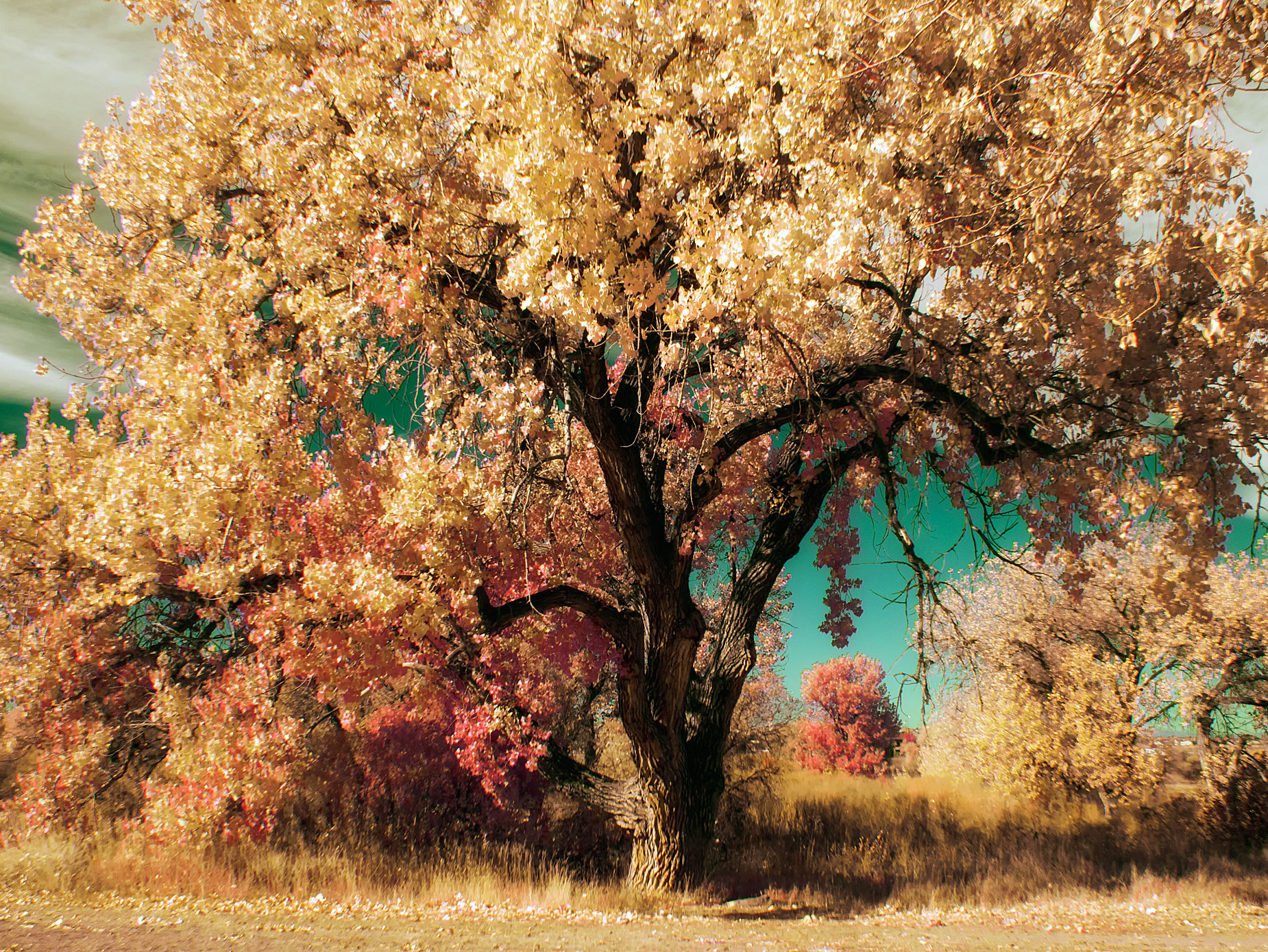
On a recent Sunday morning, Mary had to work and so, having just been given permission for my doctor to drive, I borrowed her VW Beetle and headed down the few miles from Daisy Hill to McCabe Meadows. I brought along my 16-megapixe; Panasonic Lumix GX1 that had the Life Pixel’s Hyper Color filter conversion. As is often the case, the LVF2 finder that would make shooting my Lumix GX1 easier was attached to my non-IR GX1 so I struggled with composition as I hobbled along the path dodging speed demons in electric bikes and wannabe Lance Armstrongs on racing bikes.
When I got back to my home office the first thing I did after downloading the 49 RAW+ JPEG (98 in total) files was look up the price of an LVF2 so I could finally keep one on each of these cameras. Surprise! Even the cheapest one I could find was almost $200, twice what I paid for the (used) GX!! So I moved onto looking at my “experimental” files. What I saw was surprising; the files both RAW and JPEG looked almost identical to what I would have captured on a typical sunny summer day. So I processed it almost identically and if there is any difference between how a summer’s day image and these fall images, it was that the some of the dead leaves took on a dark red tone, that I thought looked pretty nice, while other were the same as live, green leaves. So here it is…
How I Made this Photograph: I photographed my favorite tree with a Panasonic Lumix GX1 that had been IR-converted by Life Pixel with their Hyper Color filter. The lens was the Olympus M. Zuiko 17mm f/2.8 lens that one of these days I’m going to do a deep dive on it’s sharpness. The Av exposure was 1/640 sec at f/16 and ISO 400. The RAW file was processed using on of the Photoshop actions that Life Pixel once provided with some of their conversions and was further tweaked in Vivenza.
 I’ve found that Life Pixel does a great job with IR conversions and they’ve done some of the conversions for my Canon DSLRs and all of my Panasonic Lumix G-series cameras. This is not a paid or sponsored endorsement, just my experience.
Used copies of my book, The Complete Guide to Digital Infrared Photography are available from Amazon starting around nine bucks as I write this. My book Creative Digital Monochrome Effects has a chapter on IR photography and is available new from Amazon for $11.46 with used copies starting around six bucks as I write this.