
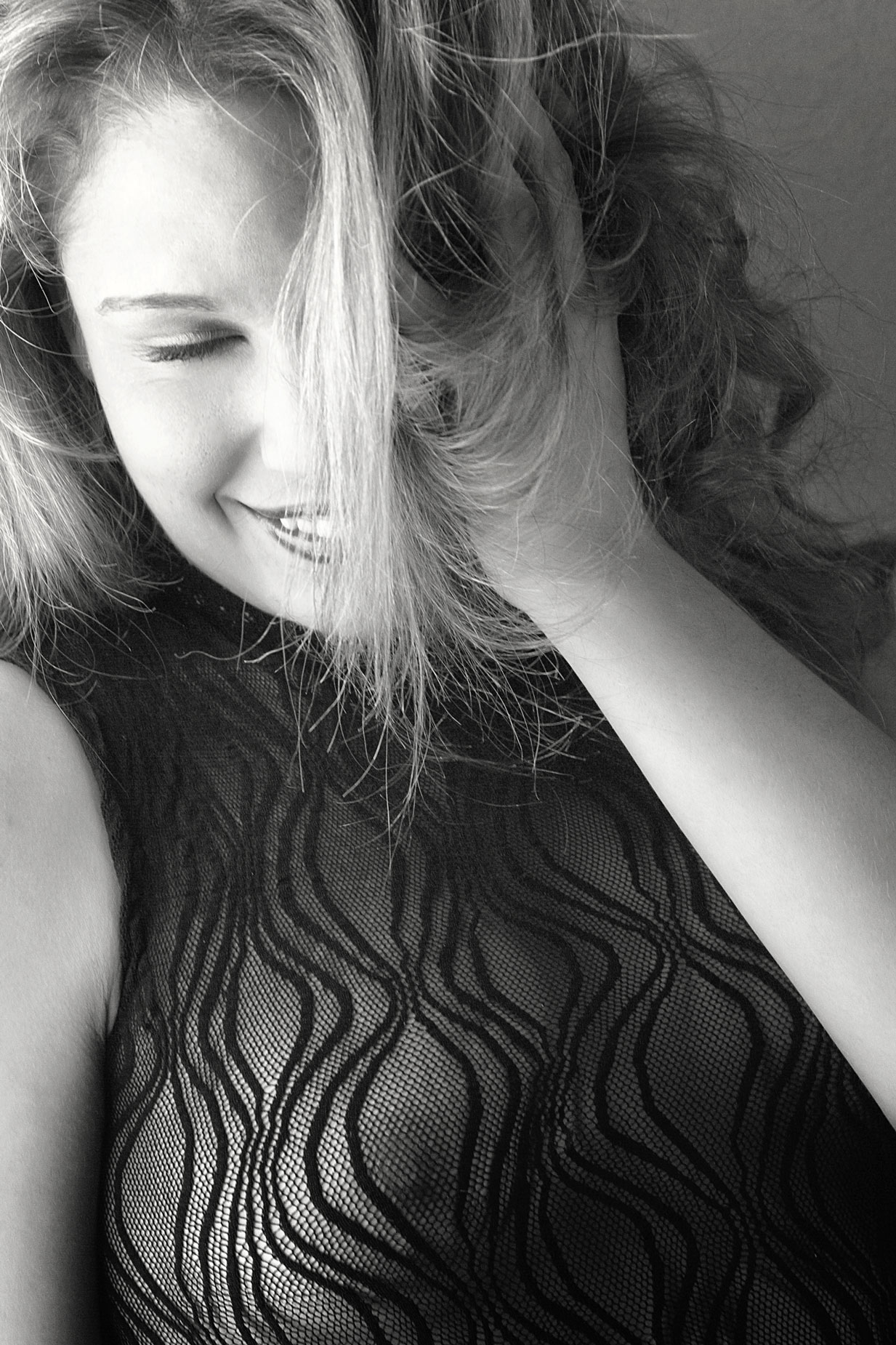
My Sunday Series on Available Light Portraiture continues today with a portrait of Leslie that was captured in the kitchen of my former home using window light from a North-facing bay window.
Today’s Post by Joe Farace
“It is good to have an end to journey toward, but it is the journey that matters in the end.”– Ursula K. Le Guin
It may come as a surprise to some readers but I didn’t start my photographic journey as a people photographer, it came later in life. When Mary and I opened our studio in 1982, we divided the workload based on what each of us were best at doing: She photographed people and I photographed things, mostly architecture and some products. If Mary was on a location assignment, I would hold down the fort in the studio by doing headshots and business portraits for clients who needed images right now! How did I do it?
Before digital photography came along, I developed a two camera rig that held a Hasselblad 500 CM and a Nikon SLR that was loaded with Polaroid’s PolaPan, which was a (more or less) instant procesing monochrome slide film. Both cameras were simultaneously triggered by using a Nikon Double Cable Release. After shooting a roll of 120 film, I would process the PolaPan slides in a minute or two and project them in our conference room to let the client choose which image they liked best. Then I would send the 120 film to the lab to process and make prints from just that one negative. Mary and I did other client-facing things with Polaroid’s instant slide film PolaChrome but that’s a story for another day.
My Personal Journey as a Photographer
 After experiencing a serious health problem, I left the studio’s operation deciding to focus my efforts on writing about photography and computers too as it turned out, Later we sold the studio to one of our employees while Mary moved onto a successful career in sales. That’s when things changed for me photographically speaking. After looking at some of the new glamour photography appearing on the Internet, especially Dave Hall’s Glamour Models forum, I became interested in photographing people. I had to start from scratch equipment wise because I had sold all my lighting equipment to a photographer/friend in Dallas because “I wasn’t going to photograph people.” That was when I learned to never, say “never.”
During this transition period, I couldn’t afford to purchase any new lighting equipment, so I started my glamour photography career by using available light for my indoor and outdoor photography. Using mostly windows lights to make these new image is how I created many of these images that appear in my Sunday posts..Later I purchased a single Paul C Buff White Lighting monolight–the OG paint can model–and later picked up some inexpensive Flashpoint monolights, which you will see used on some images in this blog. Latter I went back to using Paul C Buff monolights, which, in itself, is another story for another time. (Let me know if you’re interested in hearing that story.)
How I Made this Portrait: One of the first women I photographed after deciding to try glamour photography was Leslie, a 19-year old aspiring model. This portrait was made during one of our first shoots together and she might just have been one of my first muses because we had many fun and creative portrait sessions together after this one.
I photographed Leslie using window light from a North-facing bay window in the kitchen of my former home. The camera used was a Canon EOS D60—not a 60D—with my former go-to lens, the EF 28-105mm f/3.5-4.5 II USM lens at 58mm. Canon discontinued this useful lens but you can usually pick up used lenses from MPB or KEH for a reasonable price. The exposure was 1/160 sec at f/6.35 and ISO 800. The JPEG image was converted to monochrome using Silver Efex using their Neutral preset after using Vivenza to try and control image contrast. A horizontal (and color) version of this image appeared on the cover of one of Shutterbug’s How-to Guides.
 If you enjoyed today’s post and would like to support this blog, you can help by making a contribution via Patreon, where memberships start at just $1.25 a month, with additional levels of support at $2.50 and $5 that includes special benefits. If you do, I would like to thank you for your support.
If you’re interested in learning more about how I use cameras, lenses and lighting in my in-home studio and on location, please pick up a copy of Studio Lighting Anywhere which is available used from Amazon.com for around five bucks, as I write this. The Kindle version is $19.99 for those preferring a digital format.