
Today’s Post by Joe Farace
No place is boring, if you’ve had a good night’s sleep and have a pocket full of unexposed film.—Robert Adams
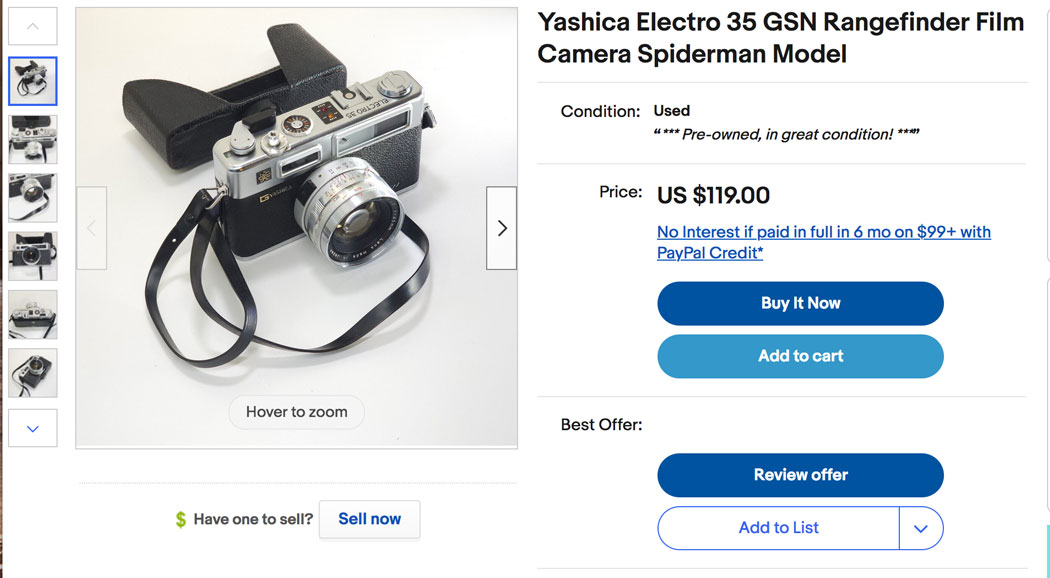 All of the 35mm film SLRS that I’ve purchased during the past two years have been purchased through eBay and all but one have been trouble free. And I guess that’s to be expected when purchasing 40-50 year old cameras.
Which is why I’ve found that buying a used film camera on eBay is not without some perils. In many ways it’s like investing in the stock market. The most important rule for investing is “not to invest money that you can’t afford to lose.” But there are a few things that, based on my experience—I recognize that yours might be different— you can do to minimize losing that investment:
The first rule is don’t spend that much money to begin with. This is simple advice and one that I am currently applying in my search for a Yashica Electro 35 GSN aka the Andrew Garfield Spiderman camera. Here’s a few more:
- Make sure that the seller includes free return shipping. Some of these camera could be 50 years old, so there might be problems that you may not want to or can’t afford to repair.
- The most important tip is to buy from sellers that have a 100% positive feedback. But be flexible. If they have a 99.3% positive rating and have made hundreds of sales, check the negative feedback and maybe give’em a try. Its almost impossible to please everyone.
- One thing that many people overlook is shipping costs. Some sellers add really high shipping costs just in case you use a “low bid” technique to get a bargain. I avoid items with high shipping costs because, once again, their use tells you a lot about the seller—not to bother with them. Some, but not all, camera store sellers offer free shipping. Obviously that’s a good deal, so always check the shipping costs before bidding.
 If you saw my video Buying Film Cameras from Japan—if you haven’t please check it out—you know that many Japanese sellers consider every one of their cameras to be “Mint” regardless of the camera’s actual condition. One thing that I have noticed is that most times these cameras have an accurate verbal description so be sure to read the text at the bottom of the listing.
If you’re not familiar with what some potential defects that are almost always listed, here’s some camera/lens defect definitions that might help with your decision to buy or not buy:
Fungus: This is produced by dust and moisture accumulating in a camera lens element and looks like small web-like spots or patches. Dust typically won’t cause problems but if it contains fungus spores and combines with moisture, it grows. Fungus can occur more commonly in non-weather sealed lenses that are used in humid climates. It can permanently decrease the performance of the lens and make images look soft.
Balsam separation: This looks like a white or rainbow halo around lens elements that are beginning to delaminate. The appearance can vary depending on the type of lens coatings used. White colors appear on lenses with no or few coatings but you’ll see a multiple colors in lenses with more coatings.
Dust: …in camera lens is not necessarily a problem. It’s only a problem depending on how big and where it’s located in the camera. I hate seeing big hunks of dust in a viewfinder and this can easily happen if the camera has a removable prism like a Nikon F or Canon F1 and “large dusts” says more to me about the camera’s care and handling. Lens dust can be a normal fact of life—again depending on how big and where it is.
Cory Ryan and Kyle Hall have written a tutorial on How to Clean a 35mm Film Camera and Lens. Please check it out. If you’re an Oscar Madison type—on the Odd Couple TV show, he was a photographer—and enjoy having nice looking gear, it’s a must read.