
Today’s Post by Joe Farace
There’s an incomparable rush that comes from finding dinosaur bones. You know you’re the first person to lay hands on a critter that lived 80 or 90 million years ago. —Jack Horner
Within an 80-mile radius of Vernal, Utah—and just a five plus hour drive from Denver—you’ll find evidence of Earth’s history at the Utah Field House of Natural History State Park Museum. This 22,000 square foot facility located in the heart of the Uinta Basin and Dinosaurland, Utah is filled with an extensive collection of dinosaur bones, full-size dinosaur replicas, and interactive exhibits that allow you to wander back in time.
 For decades scientists have come to the numerous dinosaur digs around Vernal to study and collect findings from times long past. The Utah Field House of Natural History State Park Museum was opened in 1948 to showcase a selection of these findings and share the knowledge gained here with the public.
You should start your visit in the museum’s rotunda where you’re greeted with a skeleton of a 90-foot-long Diplodocus. Be sure to check out the Fossil Lab where you can witness the uncovering, casting, and preserving of fossils. Then make your way to the Morrison Dig section of the museum that replicates the sights and sounds of a modern day dinosaur dig site. You are invited to take part in the excavation and uncover fossils by brushing away debris from the bones. Cool, huh?
Jurassic Hall takes you back 150 million years to what things may have looked like during the Morrison Formation. Here you’ll find the almost complete skeleton of a haplocanthosaurus lying beneath an allosaurus. The Eocene Gallery travels 100 million years ahead of the time in Jurassic Hall to an era when lakes covered much of the region. One wall of this exhibit is completely covered by 288 rock panels containing preserved fossilized plants. The Fluorescent Minerals room the museum has a collection of ordinary looking rocks but when flipping a switch it exposes them to ultraviolet light and you get to watch as their minerals radiate glowing colors.
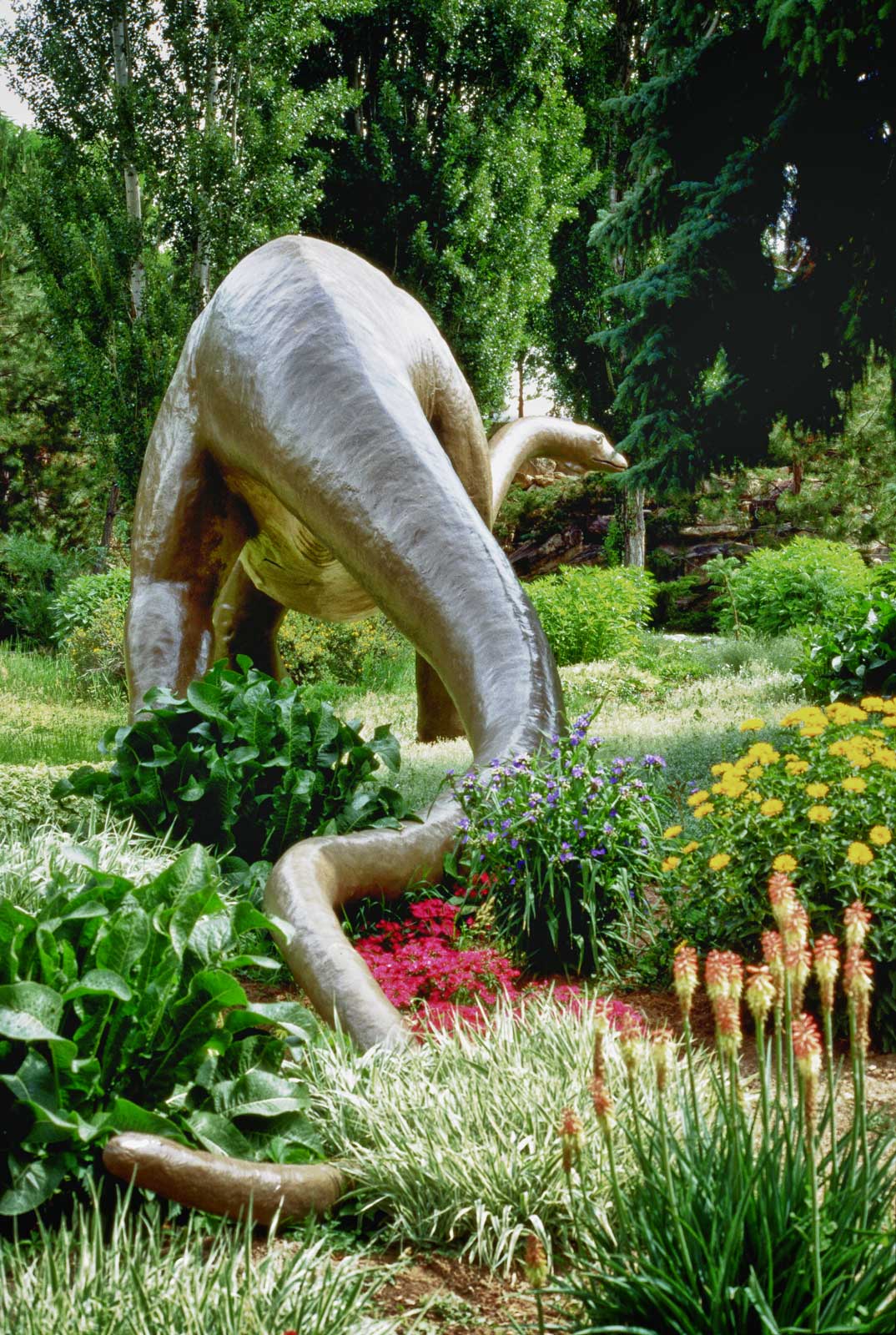
And for photographers, the Dinosaur Garden is located outside the museum and contains fourteen life-size models within a mature garden of local desert plants. These prehistoric animals are positioned in such a way to give you a good close-up experience of what it may have felt like to stand side-by-side with dinosaurs. Bring lots of film and memory cards.
How I Made this Photo: I made this image while on a road trip to Utah with my wife, Mary. We visited the Utah Field House of Natural History where I made this image in the garden that’s adjacent to their facility. It was shot on film—Kodak Ektachrome, I believe—using a Nikon N90s with the lens and exposure unrecorded. It was scanned by Kodaks Photo CD process and opened using Lemke Software’s GraphicConverter that produced fairly good quality files from a Photo CD disc but the software is not without its quirks for those people of using older computers and OS.
If you enjoyed today’s blog post and would like to buy Joe a cup of Earl Grey tea ($3.50), click here. And if you do, thank so very much.