
Today’s Post by Joe Farace
Certain people have certain ways of focusing on things and some arrange their lens to a pinhole in order to focus only on their goal. Others have a giant lens, and they take in the whole panorama.—Wendy Whelan
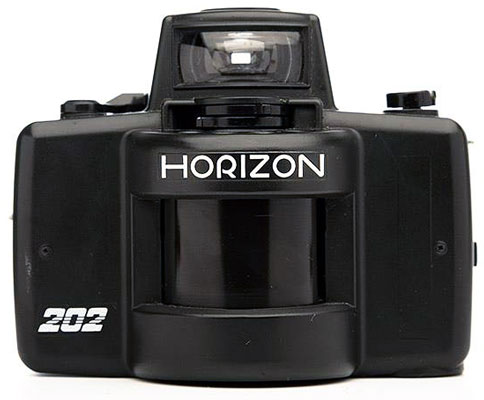 I don’t think it was a Christmas present but once upon a time my pal Jason gave me a Russian-made Horizon 202 rotating lens panoramic camera as a gift.
Thinking Wide Screen
I’ve always been fascinated with wide-screen images and really enjoyed Jeff Bridges’,first and second books of panoramic images he shot on the sets of some of the movies he’s appeared in using a 35mm Widelux camera.
Mr. Bridges’s work inspired me to shoot some film using that Horizon 202 panoramic camera taking exposure readings for this scene using a Gossen Luna-Star F2 hand-held meter. The Horizon is an all-mechanical camera, no batteries needed or included and has a rotating lens that captures a 120 degree panorama after the shutter button is pressed. The cameras were manufactured by Krasnogorsky Mechanicheskiy Zavod in Krasnogorsk, Russia, better-known for producing the line of Zenit cameras and lenses.
Working with a 35mm camera that has a 28mm focal length lens and a 120-degree angle-of-view that’s captured on a 24 x 58mm film format changes your way of looking at the world and framing a photograph. When combined with what must charitably be called an “approximate” view as seen though the viewfinder with no focusing capability, the experience brings spontaneity and maybe even a little inspiration into your photography. These days you can find these cameras on eBay for between $300 to $400 depending on condition and where they’re located in the world and tariffs and some such.
They only cheaper way to get into panoramic film photography; is perhaps the Holga 120 Panoramic Medium Format Camera that Ive seen on eBay for about $120. If you have time, check out my video on the subject of inexpensive panoramic film cameras on my YouTube channel.
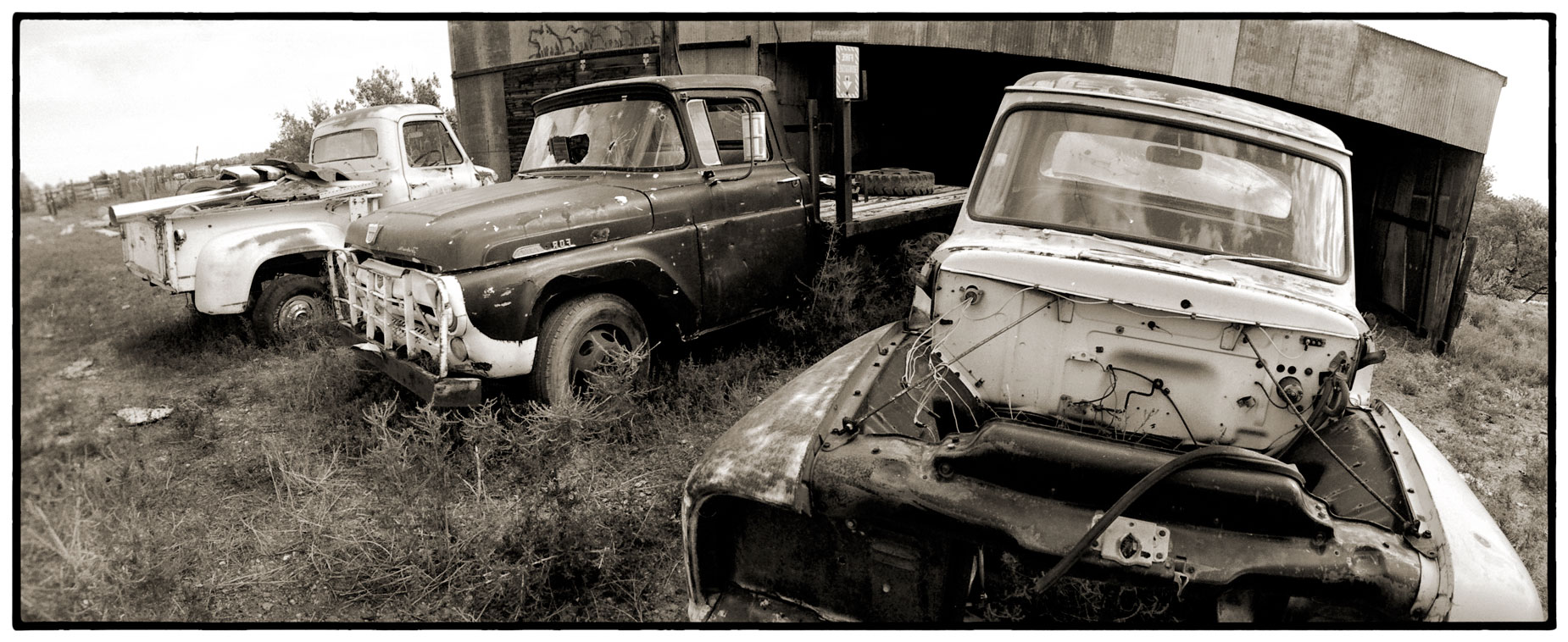
How I Made this photo: I hadn’t shot much film during the time I owned the Horizon but did manage to photograph some cars and even made some glamour portraits using it. For this image, I made readings using my Gossen hand-held meter and after having the Kodak T-Max 400 film processed, I hand trimmed the negatives and placed the strips in one of the film holders that Epson includes with some of their flatbed scanners. After scanning and tweaking the images in Adobe Photoshop suddenly I’m Jeff Bridges, Nash Bridges, Brooklyn Bridges or one of those guys.
Some time after shooting the above panoramic image, I upgraded my panoramic photography from shooting with the Horizon by purchasing a lightly used 35mm Hasselblad XPan with some of its interchangeable lenses. There are three in the system and I owned two of them. The XPan has built-in metering and auto exposure capabilities and is much easier to use than the Horizon along with much better build quality.
The XPan’s panoramic format measures 24 x 65mm but it also has a 24 X 36mm mode and is switchable between these modes as many times as you like on a roll of film. Oh yes, it shoots the film backwards. After loading the film, the entire roll in transported onto the right-hand spool and then moves the film backward into the cartridge as you shoot. When you finish the roll there’s no need to rewind.
For reasons that make me sad, I no longer own either the Hasselblad XPan or the Horizon 202.

If you enjoyed today’s blog post and would like to buy Joe a cup of Earl Grey tea ($3.50), click here.
Along with photographer Barry Staver, Joe is co-author of Better Available Light Digital Photography with new copies are available from Amazon for $24.50 and used copies starting around sixteen bucks.