
Today I’m following up on a previous Friday post entitled, IA Look at Understanding Depth of Field , with a further exploration og one of the basic precepts of film or digital photography.
Today’s Post by Joe Farace
You have to be creative. It’s the basics. You can’t be Picasso unless you know how to draw a real face; then you can turn it upside down. —Diane English
Other than shooting infrared landscapes, I’ve never considered myself to be a landscape photographer. As mentioned in a previous post, when I was student at the Maryland Institute, School of Art in Baltimore, I developed four “guidelines” for a class assignment about photographing landscapes. although I didn’t call them that at the time. All these years later, I still follow them. To be fair, these suggestions are not cast in concrete and are hereby presented for your approval for your own landscape photography:
- Photograph locally
- Use a lens with a wide angle-of-view
- Create maximum depth-of-field
- Saturate colors
A few depth-of-field basics
 When focusing a lens on a subject at a specific distance, everything on that plane of focus (at that same distance) is critically sharp. Objects that are not on that same plane of focus are theoretically out of focus but there is a range of what could be called acceptable sharpness that exists and that’s called depth-of-field. Here’s how it works:
How big is that range? One-third of the area in front of the plane of critical focus and two-thirds behind it are theoretically in focus. Increasing a photograph’s depth-of-field also increases the image’s overall apparent level of sharpness by including more objects in the scene that are seen as acceptably sharp.
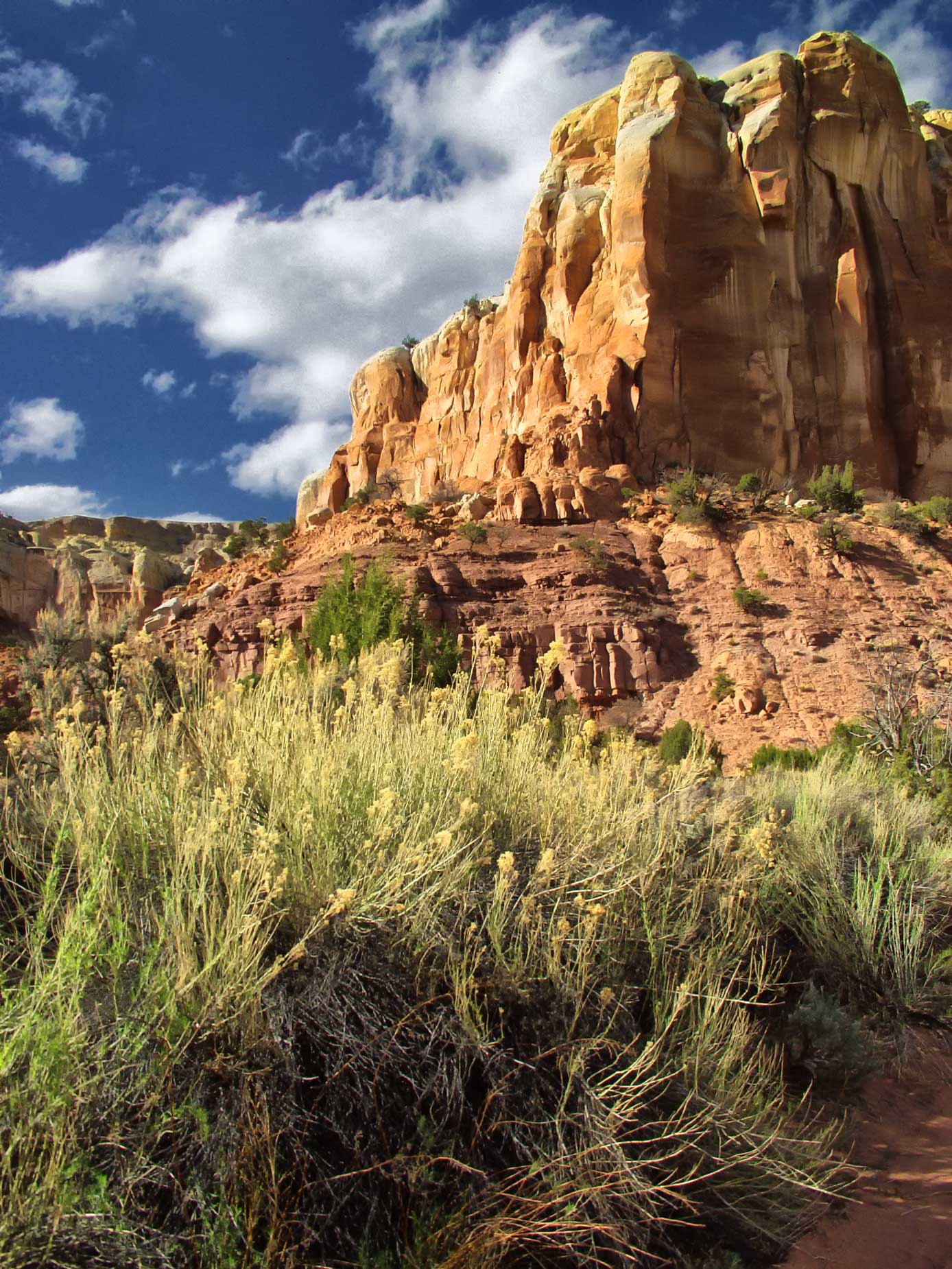
How I Made this photograph: I made this image at Ghost Ranch in New Mexico when I was teaching a workshop in New Mexico. I typically don’t shoot many images when teaching a workshop, preferring to give my full attention to the students but occasionally will make a few shots, like this one, during a PhotoWalk. It was made with a 5.2-megapixel Olympus E-20 (although the EXIF data says it could be an E-20N or E-20P.) The built-in 35-140mm (equivalent) lens was at 35mm. The exposure was 1/640 sec at f/4 and ISO 80 and was shot handheld.
Depth-of-field will vary depending on lens focal length, the distance to the subject and lens aperture. Using a lens that has a wide angle-of-view increases apparent depth-of-field (guideline #2) while using a longer focal length lens decreases it. One general principle being that as the aperture size decreases, the depth-of-field increases and increasing the size of the lens aperture decreases depth-of-field along along with the area of acceptable sharpness.
What about Diffraction?
Diffraction is an optical effect that limits the total resolution of your photography no matter how many megapixels the sensor in your DSLR or mirrorless camera has. It occurs when light passes through am aperture with a small aperture when both the wavelength of light and the opening itself are roughly the same size. Sadly the only way to avoid diffraction is to use a larger (wider) aperture. Finding a lens’s “sweet spot” is the only way to avoid the effects of diffraction. For my take on how to handle diffraction check out my post Not the Sharpest Knife in the Drawer.
When diffraction is under control, my personal rule for landscape photography is still to use the smallest appropriate aperture to produce the greatest of depth-of-field. This may mean you may have to use a tripod to steady your camera because of the slow shutter speeds produced at smaller apertures. If you have time read my post Four Reasons to Use a tripod. Working with a tripod also enforces a slower more deliberate approach to composing images, so a side benefit is that the composition of your image may be a little stronger. As an alternative, you can use more modern cameras that have five or more stops of built-in image stabilization. Please read my post called I’ve Changed My Mind about my shooting tripod free when using the Olympus M-1X.
*Just a reminder: Podcast #7—the Holiday Episode—is live now on my YouTube channel, Joe Farace’s Videos, featuring a look at how Barry Staver and I photograph people, and sometimes other primates!