
On December 15, it’s International Tea Day and we celebrate it by drinking the most popular beverage in the world. Today my choice was Breakfast Blend by Fortnum and Mason. This day seeks to raise awareness on the impact that the tea trade has on farmers and workers and is celebrated by tea lovers worldwide.
Today’s Post by Joe Farace
You can’t get a cup of tea big enough or a book long enough to suit me. — C. S. Lewis
Litho film Is/was available under a variety of different trade names, including Kodalith by Kodak, PL Line Ortho by 3M,and Cronar by Du Pont. Back in the day,I shot some 35mm Cronar; now where are those negatives?
What is Kodalith?
 Kodalith is a extremely high contrast, orthochromatic film that was designed for making line and halftone negatives for photomechanical reproduction. It has a low (maybe two?) ISO, wide exposure and development latitude and was also used for making highlight masks to improve highlight detail when making duplicate transparencies.
- Orthochromatic films can only see blue light. Reds are rendered darker and it therefore creates darker looking skin tones.
- Panchromatic film is sensitive to all wavelengths of visible light and typically produces a black and white (negative) image.
In the film era, Kodalith was the gateway to working in the wet darkroom to emulate antique and lost printing techniques. I have many fond memories of learning all about using Kodalith in Beverly Wilgus’s class, Photosensitive Materials, when attending the Maryland Institute, College of Art.
In those days and maybe still today, photographers wishing to try reproduce arcane printing techniques would make contact-sized negatives—often the only way to make prints with these processes— using Kodalith sheet film produced from their 35mm originals. Typically slide film was used to produce a negative on Kodalith.
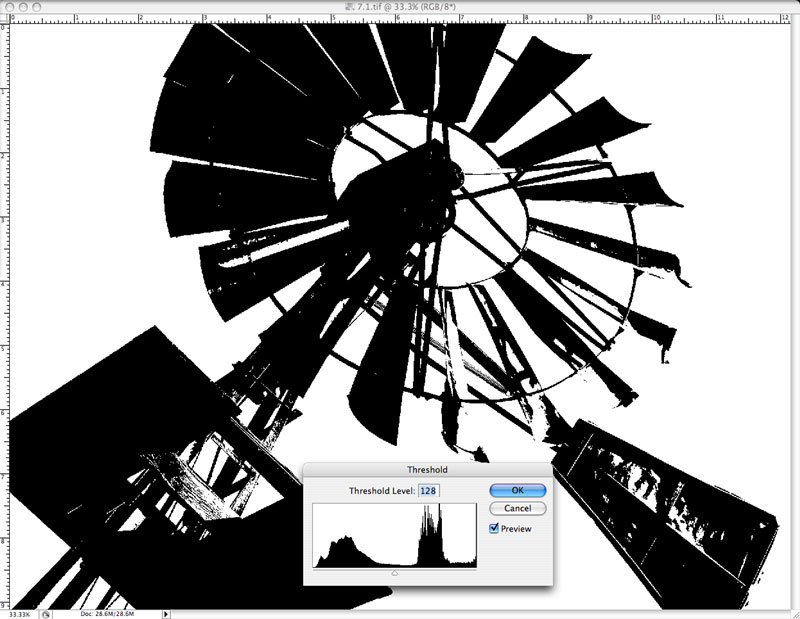 That was then; this is now. Here’s a digital way to accomplish a look similar to old processes that formerly required you dunking your fingers or tongs into smelly and potentially hazardous chemicals. Since so many process required the use of Kodalith, it’s worth a look at a few digital techniques for producing Kodalith-like effects in the digital darkroom.
How Mary made this photograph (above right): When we lived in rural Colorado, one of Mary’s and my favorite places to make photographs was the Adams County Historical Museum. That’s where Mary captured this image of a windmill using an Olympus E-510 DSLR (before she got mad at Olympus and switched to Nikon) and a Zuiko Digital ED 14-42mm f/3.5–5.6 lens. The exposure was 1/800 sec at f/5 and ISO 200.
Photoshop’s Thresholds (Image > Adjustments >Threshold) command lets you create high contrast images from within the program. To identify a highlight, drag the slider to the far right until the image becomes pure black. Drag the Threshold slider slowly toward the center until some solid white areas will begin to appear in the image. Or you can drag the slider to the far left until the image becomes pure white then drag it slowly toward the center until some solid black areas appear in the image.

Photoshop’s Stamp and Torn Edges filters will also let you create high contract images but Thresholds will also do the same thing. It’s your call.
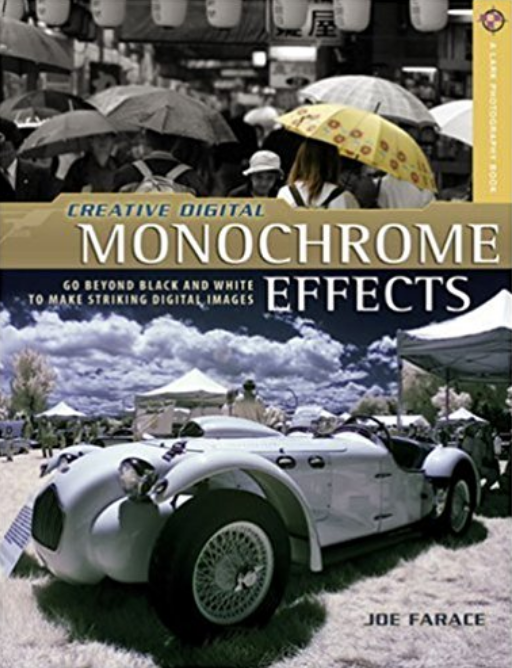
Copies of my book Creative Digital Monochrome Effects are available from Amazon with new copies selling for $11.46 with used copies starting around ten bucks, so why not spring for the new book?. No Kindle version is currently available, sorry.