
In 1972 journalist Harold Pullman Coffin proposed National Nothing Day as a “non-event” to be observed — by doing nothing — every January 16. Since the trappings and pomp of the holiday literally add up to nothing, like its namesake, there’s not a lot to tell.
Today’s Post by Joe Farace
“An investment in knowledge pays the best interest.” — Benjamin Franklin
There’s an old photographer’s saying that “if you take care of your equipment it will take care of you.” ——I think I made it up.
Several years ago, I attended a hot rod show planning to make some photographs for my car photography blog. Sometime during that day I accidentally scratched the front element of my Canon EF 10-22mm EF-S lens. This wasn’t the first time I’ve done something this stupid but hoped it will be the last. It wasn’t.
Here are a few suggestions that might save you the cost of an expensive repair or, worse yet, replacement of one of your favorite and possibly expensive lenses
Taking Care of Your Gear
 When it comes to caring for camera equipment, I think there are two categories of photographers: The first group are the Oscar Madisons whose idea of cleaning a lens is to lick the front element and wipe it off with a pulled-out shirttail. The opposite extreme is obviously the Felix Ungers whose equipment looks as if they never use it. Many of us find ourselves somewhere in between these two extremes, although I’ll confess to some Unger-like impulses about caring for my photo equipment. But the older I get that tendency seems to be fading.
Based on several bad experiences, when working under less than ideal conditions, I’ve found that it’s a good idea to attach a UV or Skylight filter to the front of my lenses but know some photographers disagree with this practice. They feel that using any kind of filter, no matter how high its quality, degrades the optical performance of the lens. That may be why some photographers never put any filter on a lens unless it’s to produce a specific visual effect.
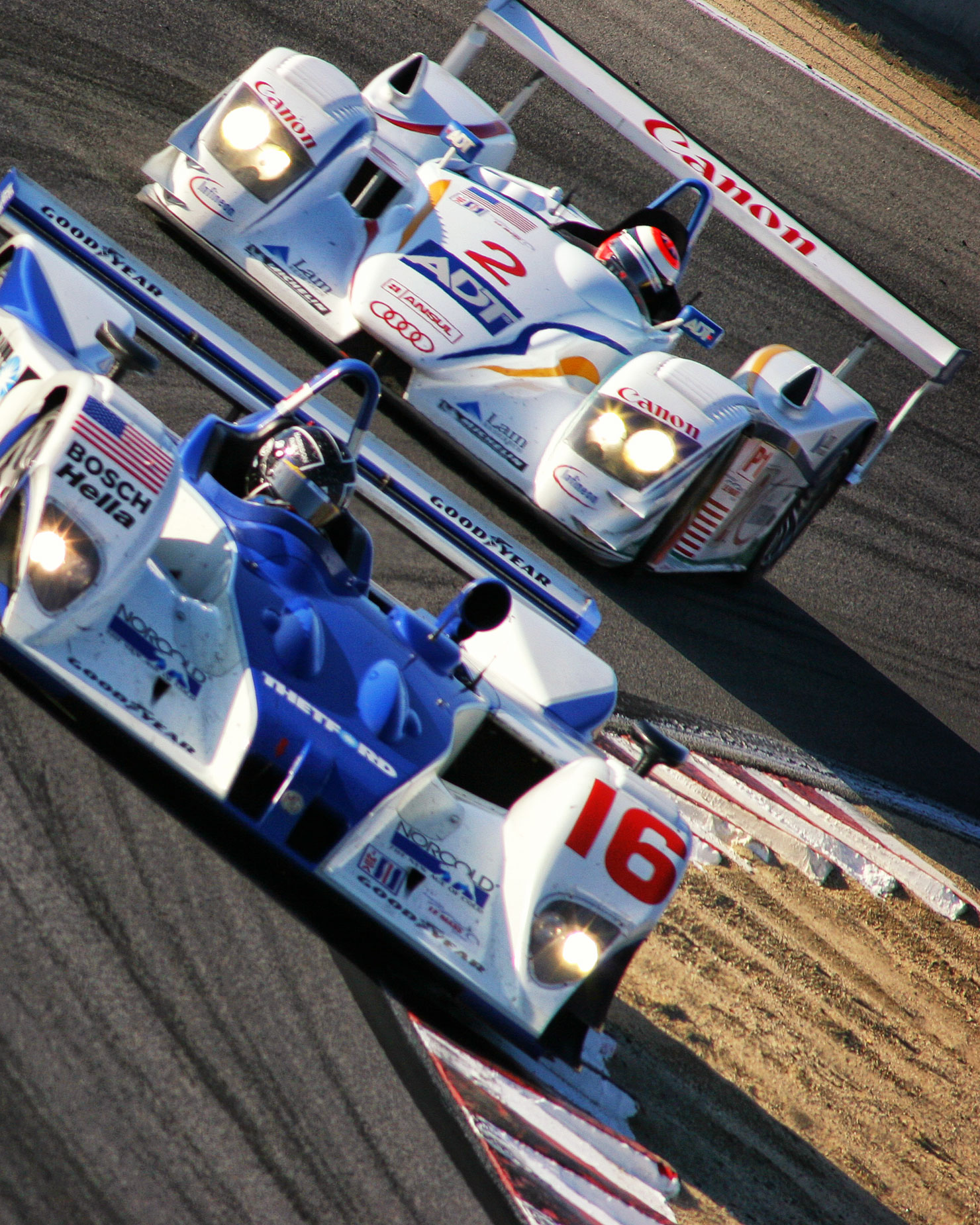
How I Made this Photograph: I photographed these two American LeMans Series cars during a race at Laguna Seca Raceway using a Canon EOS 20D and an EF 75-300mm f/4-5.6 III lens (at 200mm.) The exposure was 1/500 sec at f.10 and ISO 200 with a minus one and one-thirds exposure compensation.
What Kind of Filters
I’ve found that a Haze or Skylight 1A filter provides an effective ounce of prevention in those photographic situations where there’s blowing dirt, saltwater spray or crowds. It seems obvious that you would want to use a high quality filter but I’m often surprised to see a cheap filters used on cameras such as a Leica.
An alternative to using a Haze or Skylight filter is Tiffen’s Clear filter that’s made of clear optical glass. As far as additonal functionality is concerned, a Skylight filter typically absorbs 45.5% of UV light, while a Haze filter provides 71% absorption. Photographers, like me, who live at high altitudes— halfway up Daisy Hill it’s 6120 ft— and routinely shoot at higher altitudes may want to use a Haze 2A that absorbs virtually all UV light.
Several times in the past, while on different assignment, I’ve had a chance to test my current practice of keeping a Haze or Skylight filter attached to my lenses. One incident occurred when photographing an Olympic gymnastic competition and during a break in the action, I glanced at the front of my 300mm f/2.8 lens. Right across the middle of the filter was a giant scratch! I don’t know how it happened but it was much less expensive to replace that filter than the lens it protected.
Another way to protect your lens is to use a lens hood. Be sure to get one that’s designed for your specific lens to prevent vignetting. In addition to protecting your lens, any time you can prevent non-image forming light from striking the front element of your lens, the overall image quality will improve. Additionally, wide-angle lenses users should make sure they use thin-mount filters, such as are offered by B+W, Hoya, and Tiffen, to prevent vignetting when using lens hoods.
If you enjoyed today’s blog post and would like to treat me to a cup of Earl Grey tea ($2.50), click here. And if you do, thank you very much.